
What does sound and nature to do with each other? A lot actually. What is sound to you and how can you use it for healing? What resonates? What doesn’t resonate and why?
Sound can show up in so many forms and ways including the sound of birds chirping in the morning and the sound of a brook running past our bedroom window. Since our body is all energy –– and it stretches so much further than most of us realize — we can use various forms of sound to reach us energetically through the various frequencies and tones that most resonate with us.

How to Bring More Music & Healing into Your Life
We are big believers of using sound as a way to heal and in fact, use crystal bowls, particular hz sound tracks during meditations, Tibetan bowls, Shamanic drums, Djembe drums, gongs, shakers and a host of other tools to bring meaning, purpose and healing into groups and when we work one-on-one. We also use these tools ourselves for when you heal yourself, you heal others and the contrary is true as well.
Let’s take a look at three additional ways sound can enhance your practice, whether you’re a practitioner or someone who simply wishes to bring more healing and serenity into your every day life.
Gaia Koshi Chimes
During a sound healing course I took in the SF Bay Area, I had the opportunity to experience Gaia Koshi Chimes for the first time. They are so mesmerizing that I had to learn more.
We were so excited to receive a complete set of all four Koshi chimes to review and since they arrived, we use them all the time, even if when we are simply sitting on the deck enjoying a cuppa tea.
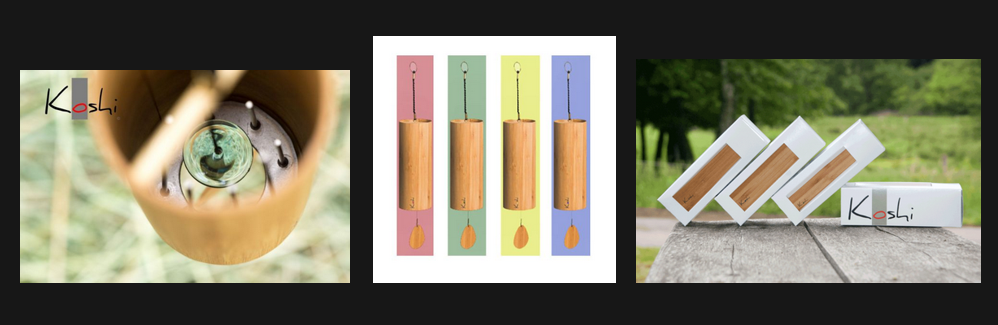
Gaia Koshi Chimes
The Koshi chimes are handmade in a workshop at the foot of the Pyrenean mountains in France. Each chime is the result of meticulous craftsmanship where eight chords are welded with silver into the metal plate at the base of the bamboo resonance tube.
What Makes Them Unique?
Precise tuning creates a play of clear tones that is rich in overtones, of which the shorter chords successively dominate and become fundamentals, forming a circular tone range. You can move your Koshi chime gently by holding it by its cord or suspend it and it will play with the wind carrying you away in an unexpected melody.
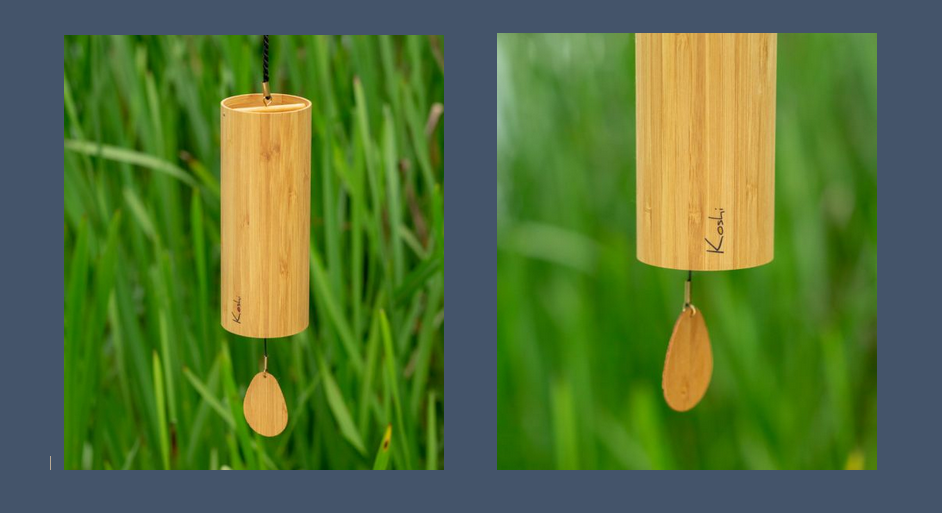
They are stunning as well — just look at the artistry here.
Each Koshi produces it’s own sound influenced by the four elements with it’s own timbre. For example, each corresponds to specific Koshi notes and an element.
Koshi Notes
-
Air: a c e a b c e b
-
Fire: g b d g b d g a
-
Earth: g c e f g c e g
-
Water: a d f g a d f a
Aside from the unique elements that are woven into each individual chime, they are made of bamboo and simply beautiful to look at, hold and hear.

We absolutely love these chimes and use them frequently, including during our online courses and occasionally during a one-on-one session. We also use them ourselves when we simply want to relax — they’re mesmerizing to listen to and you’ll find that you won’t want to put them down.
For more information including how to order, visit their website.
Blue Bear Flutes
Truth be told, Anthony and I have always wanted to play with indigenous flutes. Over the years, I’ve heard them being played but never had the opportunity to try one myself. Neither one of us are up to the task of taking flute lessons however with some of the simpler ones, there’s no need to since there are online tutorials and videos that can help you learn the basics.
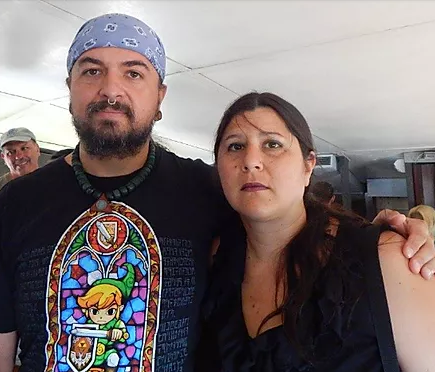
Charlie and his wife Jessie
We came across a unique site and manufacturer of flutes with the coolest name ever: Blue Bear Flutes. Behind the vision and the flute designs and craftmanship is Charlie Mato-Toyela who has been handcrafting flutes for over 30 years.
He and his team offer authentic and affordable Native American Flutes and they specialize in Native American Flutes for beginners, intermediate level as well as for advanced players.
Originally, Charlie got involved with flutes through his grandfather as well as a cousin who helped me learn more about them. In addition to a host of ways he weaves flutes into his life, he also entertains others while enjoying a “oneness” with nature.
We were offered the opportunity to review a couple of his flutes and couldn’t be more thrilled to participate. Wow, right? I had no idea at the time how much fun it was going to be.
Flute Options
Since we don’t know how to play the flute, obviously it made sense to go for an option better suited for beginners. The smaller, simpler flute of the two that he sent us is one of what Charlie refers to as a “simple traditions flute.” It is a new type that they started making which is a wooden flute made in the similar fashion to their original Rivercane Flutes.
Says Charlie about the new style they now offer:
“The flutes are made out of poplar wood which is a sustainably harvested hardwood. I like this flute type for its simple design and open mouth piece which has a great deal of benefit for the flute player. It is not required to put your mouth around the flute but only place the flute against your lips to blow through it. This type of mouthpiece gives the flute player more control over the air being used and helps to prevent wetting out which is a common problem of Native American flutes.”
The simple traditions flute is one that could be played along with other music, in various ceremonies, for meditation and so much more.
The 5th Drone
The larger of the two flutes that he sent us is what is called the 5th drone. They apparently nickname them “Mayan or Aztec Temple drones“ because ancient cultures of Central America made drone flutes that were harmonious types similar to this one.
Many of the original drone flutes from Mexico were apparently shaped like snakes and other animals. On a side note, they travel to Mexico often and have friends there who still make flutes like those today.
Charlie explains what makes a 5th drone flute a 5th drone flute. It apparently has to do with the two sides of the flute which are made based on the circle of fifths which is a mathematical system of determining chords and progressions.
I asked him for what purpose he mostly uses drone flutes and he says that he typically uses the 5th drone as a fun type of harmony-instrument. Charlie notes: “Because it is made from a flute in the key of E as well as a flute in the key of high B, it can be played with either of those 2 flutes as well. It also sounds most excellent by itself.”
Most of the flutes they have made are of Western Cedar but recently, he has begun to offer the 5th drone in poplar.
They offer many flute playing videos and his favorite is “How to Play the Native American Flute in Under 10 minutes” series. Check out this video of the 5thdrone as well as a video of them playing flutes. videos
Additionally, they offer free classes on flute making, flute playing and general info about Native American culture, especially the flute. They also offer clay whistles, Eagle whistles, flute amps, accessories and flute bags.
For more information including how to order, be sure to visit their website. It’s an experience you’ll definitely want to try — the sound is so beautiful not to mention healing.
Tuning Forks for Vibrational Healing
First of all, I’ll start with the book that introduced me to this incredible work — Tuning the Human Biofield by Eileen Day McKusick.
 It was one of the books I read prior to taking Minna’s sound healing course in northern California. One of the things we love about the book is that she takes you on a journey through the history of sound and all of what it IS in essence, from the history, the power of the words we say, how sound balancing came to be, how to use sound therapeutically, the biofield in science and why it matters, and how to use tuning forks for healing in that Biofield.
And much much more of course.
It’s an amazing read regardless of you get started using tuning forks or not. Eileen founded The Biofield Tuning Institute (based in Vermont), which aims to advance biofield science through conducting peer-reviewed research and developing biofield-sensing technologies.
One of the other things they seek to do is bring “Tuners without Borders” to at-risk populations worldwide. Bravo bravo! As explained on McKusick’s site:
“Biofield Tuning challenges the widely held scientific view that consciousness exists because of and within the brain. Rather, Biofield Tuning is based on a vibrational medicine view of health that enables Biofield Tuning practitioners to identify and work with both mind and memory through an interaction with a person’s biological field, or biofield. The biofield is a complex organizing information/energy field that is engaged in the generation, maintenance, and regulation of biological functioning.”
Why is this profound? Why does it matter?
Because in this Biofield, healing can occur and tuning forks are one method used in that healing process. We had a chance to learn more. We were given an opportunity to review their Biofield Tuning Toolkit, which includes everything you would need to participate in one of their certification programs, but also all of the tools needed to learn from home in order to practice on friends and family.

In the kit, you receive McKusick’s book, and five tuning forks created and designed specifically for the Biofield Tuning process: 174 hz, 528 hz, 417 hz, 54.81 hz and 62.64 hz. There’s also an instruction video series, a laminated Biofield anatomy map, a hockey puck activator and a neutral acrylic pendulum.
They make sure to note that the basics through the included instructional video does not qualify you to practice Biofield Tuning professionally since you must take the first two levels of their courses to receive certification. If you’re not ready to dive into the entire kit, their classes or certification, they also offer individual tuning forks, Sonic sliders and accessories separately as well.

For more information, visit their website as well as the Biofield Tuning Clinic as well. You can take a class, go on a retreat or participate in training/advanced training to become a practitioner as well. It’s powerful stuff.
_____________________________
Note: we were sent products to review but all opinions expressed are entirely our own.

Renee Blodgett is the Founder and Managing Editor of We Blog the World, a global travel, culture and lifestyle publication exploring the world through the lens of meaningful experiences, human connection and cultural depth. Having lived in 10 countries and traveled to 95, Renee has spent much of her life immersed in the people, traditions, landscapes and ideas that shape how we experience the world.
Since launching We Blog the World in 2007, she has written and produced extensive editorial coverage spanning boutique and luxury travel, culinary experiences, arts and culture, wellness, adventure, technology, spiritual traditions and transformative travel. Her work is rooted in the belief that travel is about more than where we go—it is also about what a place, culture or encounter awakens within us.
Renee brings more than three decades of experience across journalism, photography, media, brand strategy, technology, wellness and global storytelling. She has worked with companies and organizations around the world on brand positioning, communications, product launches, media strategy, speaker positioning and storytelling. Through Blue Soul Media, she works with authors, entrepreneurs, thought leaders and purpose-driven brands to clarify their message and expand their impact, which includes speaker coaching/training for high-profile stages such as TED and bringing authors’ work to market while retaining authors rights.
She is also the co-founder of Blue Soul Earth, an educational platform exploring consciousness, ancient wisdom, spirituality, healing and the intersection between science and the nature of reality. Renee is the producer and host of the award-winning Blue Soul CHATS, a conversational series bringing together leading voices in science, technology, consciousness, wellness and spirituality.
Her growing body of work also includes Blue Soul Living, which extends her interest in consciousness and well-being into the spaces we inhabit, exploring how intentional design, energy and environment can support greater harmony and connection.
Renee is the award-winning co-author of the bestselling Magdalene’s Journey and founder of the Magdalene Collection, inspired by women’s voices, stories and wisdom across cultures and generations.
A longtime photographer and storyteller, Renee has documented people, places and cultures around the world and produced photographic collections focused on destinations including the Galápagos Islands, London, South Africa, Rome and Ecuador. She also co-founded Traveling Geeks, an international initiative that brought entrepreneurs, journalists, creators and technology leaders together with their counterparts in other countries to exchange ideas and explore innovation across cultures.
Renee’s work has been recognized by Forbes, the United Nations and others for her influence in media and social storytelling. Across her work in travel, media, consciousness and culture, a common thread remains: curiosity about the world, the stories that connect us and the ways meaningful experiences can change how we see ourselves and one another.