
You’ve probably heard that cell phones may be harmful when placed close to your head somewhere on a passing news report or morning talk show, but the segment is so short lived that you may pay attention for a moment or two, mention it to someone later and then move on with your daily lives. The naysayer technologists will go to great lengths to prove that any report saying that they’re unsafe is unfounded and not reliable.
In my circles, which is in the heart of Silicon Valley, I have these conversations all the time. The moment I bring up the issue of EMF issues for cell phones, the conversation always gets a little weird…..people suddenly start fidgeting and looking for any excuse at all to change the subject, as if I’m the party pooper aka the big elephant in the room they want to silence. After all, who wants to talk about the negative effect of cell phones when you know yourself that you just spent the last 5, 10, 15, 20, maybe 25 years using one, all without protective measures? Let’s face it — “it’s not a fun conversation.”
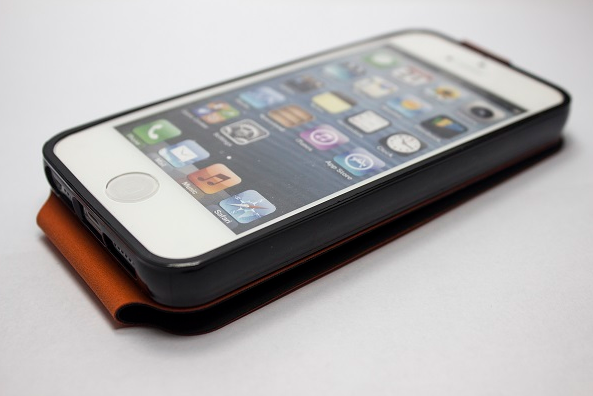
Above is the case for the iPhone 6.
The scariest part of ignoring this conversation however is that if they ignore it for themselves, they’re likely ignoring it for their children too who may be getting on cell phones as early as 7 or 8 years old – imagine the compound interest effect of EMF from regular cell phone use by the time they’re only 30? A couple of years ago in a 2013 article by Don Maisch Ph.D. from EMFacts Consultancy, he talks about the impact of cell phones starting from the 2011 International Agency for Research on Cancer (IARC) statement which classified cell phone radiation as a possible human carcinogen. He goes onto say that since then, a number of important developments have strengthened the IARC ruling. From his article:
- On January 7, 2013, a report was released by the Bioinitiative Working Group that reviewed over 1,800 new scientific studies. The 21 chapter report, written by 29 scientists and public health experts concluded, in part, that there is a consistent pattern of increased risk of malignant brain tumours with prolonged use of cell phones and cordless phones.
- On January 3, 2013 A Swedish meta-analysis of previous data on brain tumour risk and the use of cell phones concluded that the existing radiofrequency exposure standards are not adequate to protect public health.
- December 2012: A study of cell phone users in Saudi Arabia, where cell phone use is one of the highest in the world, found that prolonged use of cell phones was associated with a number of health problems, including fatigue, headaches, dizziness, tension and sleep disturbance.
If you want more data, there’s a ton of it out there, and yet its astonishing that people still don’t talk about it openly in a way that spreads these alarming facts and in particular pushes teenagers to either use a tube protected ear phone which dramatically reduces the emissions that reach the head and to turn them on Airplane Mode when they’re in their rooms at night or in their pockets. Sadly, I know young women who wear their iPhone 6 tucked in their sports bras while they’re on the treadmill so Fitbit can track their steps. My friend Jeromy Johnson who left his full time career as an accountant and technologist to research the risks and report on them, has told me on more than one occasion – Airplane Mode is your friend.
I’ve mentioned this to several people since picking up the habit myself, but its likely that 90% of those people won’t even take the small protective measure of turning their phones on airplane mode when not in use. Why not? Because so many of them still don’t believe it’s a real concern and others are either lazy or too ingrained in their habits to make a change. Meet the Cruz Cell Phone Case I discovered on the Less EMF website, which also has a boat load of other products that help protect you from EMF pollution.

They’re a small company and I couldn’t applaud their efforts more — what they’re doing here is not just a cool thing, it’s a potentially life saving one in my opinion. Essentially the goal of the Cruz cell phone case is to stop the signals aimed at the head. The case is also fairly durable with 360 dent resistant protection, display screen protection since it has a lid, a text privacy guard (also useful) and a credit card holder on the left hand inside flap of the case.
There’s also a dust cover which helps to keep the screen clean and a patent pending cover guard. The newest version which I just got my paws on, has an ultra slim design so it’s much lighter and thinner than the previous case. The cool thing about how they’ve designed it is that the case blocks the cell signals aimed at your head without you changing the way you use your smart phone. You obviously need to open the case to take the call, but once you have answered it, simply close the case and begin talking through into the open area to your microphone.

In doing this, it protects you from the EMF radiating from your phone. It reflects back the powerful radio signals directed to head and body and yet there is apparently no interference with cell tower signals. The other great thing is that because you have a case on both sides of the phone, its added protection when its sitting in your pocket, which men tend to do often, sometimes in their shirt pocket which is bad news! Seriously, as more and more negative reports come out, why would you consider taking risks?
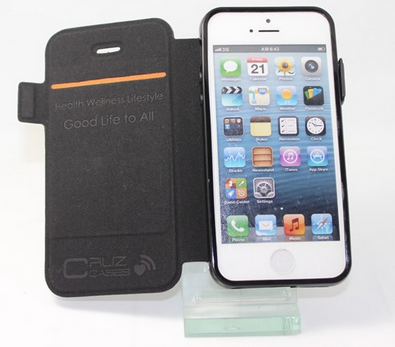
Here’s a short video showing you how to use it and why you should care. The cases support iPhone 5, iPhone 6 and the Samsung S5 and are only priced at $40, an inexpensive investment if you truly value your health. Below is the view of the Samsung S5 cover when open.

I really love their attempt at keeping people safe so I’m hesitant to bring up my only beef, but I’m going to and here’s why. My beef is the color and the fact that the logo is on the front. Anyone in marketing has heard the story about the early days of the Ford Motor Car when it was only available in BLACK and customization only came as cars became a regular purchase for average Americans. The bottom line is this and women and teenagers (more at risk for EMF pollution) will resonate with what I’m about to say.
Cell phone cases are an image statement for some and for others, we choose them simply because we love the case design or the colors. As anyone who has gone to CES knows, there are aisles and aisles of Asian cell phone case manufacturers who sell everything from animals on the back of cases, to nature, urban, fashion, sports and art.
I realize that as a small company, it’s hard to offer a wide array of design cases for a cell phone, especially if the case is expensive to make and serves a primary purpose. That said, a few color choices should be a must on their marketing and business plan list, especially without the logo plastered on the front. My current case is purple and it also adds extra charge to my iPhone, a really nice feature and a handy one when your juice is running out. Having an all black with a logo design (in orange of all colors) on the front raised the eyebrows of my boyfriend’s 8 year old son — he loves it, but for an adult woman who is used to choice, it’s a barrier to using and loving it.
My argument for bringing up my only beef is this: if you are truly going to get mainstream adoption, you need to remove all barriers to entry and design/style and color is a major one for an accessory that so often defines people’s personalities, in the same way a purse does or a cover for our laptops and iPads. It was like eye candy for the soul when I walked into the SPECK booth at CES two years ago to find a zillion colored cases for Mac Books and Mac Book Pros. Take a look at SPECK review from 2013 that is screaming in joy over their color choices – hell, at the time they came out, I had 2 or 3 colors so I could swap them out depending on my mood.
If you want adoption to be prolific then come out with colorful stylish options (and I don’t mean bright red or orange) and nuke the logo off the front so women can embrace the case, tell their friends, moms and other concerned souls on Facebook and any and everywhere else online that will get some eyeballs. As for the geeky guys who are okay with a black and orange case, sadly the men in my circles still don’t think EMF is a real issue. Women will care more. Mothers will care EVEN more. Target them in a big way and let us all help you get the word out virally. You need a close to a zero barrier to entry so the education aspect of harmful EMF in our environment proliferates at a massive scale.
Amen….or something like that!
A few useful resources for your reading pleasure:
- EMF Analysis – background information on EMF with plenty of other useful resources.
- Less EMF – data and products to reduce the amount of EMF you’re getting hit with every day.
- EMFacts – a site about the issues around EMF which includes links and info on reports which have been done.
- My round-up on other useful products that can help protect you.
All photos from the Cruz corporate website.
Note: I do not make any claims that this case will protect you from EMF and am not a doctor or a technologist. I merely care about the growing issues and proliferation of EMF and want to share products that I’m learning about which are trying to add protection to the human body.

Renee Blodgett is the Founder and Managing Editor of We Blog the World, a global travel, culture and lifestyle publication exploring the world through the lens of meaningful experiences, human connection and cultural depth. Having lived in 10 countries and traveled to 95, Renee has spent much of her life immersed in the people, traditions, landscapes and ideas that shape how we experience the world.
Since launching We Blog the World in 2007, she has written and produced extensive editorial coverage spanning boutique and luxury travel, culinary experiences, arts and culture, wellness, adventure, technology, spiritual traditions and transformative travel. Her work is rooted in the belief that travel is about more than where we go—it is also about what a place, culture or encounter awakens within us.
Renee brings more than three decades of experience across journalism, photography, media, brand strategy, technology, wellness and global storytelling. She has worked with companies and organizations around the world on brand positioning, communications, product launches, media strategy, speaker positioning and storytelling. Through Blue Soul Media, she works with authors, entrepreneurs, thought leaders and purpose-driven brands to clarify their message and expand their impact, which includes speaker coaching/training for high-profile stages such as TED and bringing authors’ work to market while retaining authors rights.
She is also the co-founder of Blue Soul Earth, an educational platform exploring consciousness, ancient wisdom, spirituality, healing and the intersection between science and the nature of reality. Renee is the producer and host of the award-winning Blue Soul CHATS, a conversational series bringing together leading voices in science, technology, consciousness, wellness and spirituality.
Her growing body of work also includes Blue Soul Living, which extends her interest in consciousness and well-being into the spaces we inhabit, exploring how intentional design, energy and environment can support greater harmony and connection.
Renee is the award-winning co-author of the bestselling Magdalene’s Journey and founder of the Magdalene Collection, inspired by women’s voices, stories and wisdom across cultures and generations.
A longtime photographer and storyteller, Renee has documented people, places and cultures around the world and produced photographic collections focused on destinations including the Galápagos Islands, London, South Africa, Rome and Ecuador. She also co-founded Traveling Geeks, an international initiative that brought entrepreneurs, journalists, creators and technology leaders together with their counterparts in other countries to exchange ideas and explore innovation across cultures.
Renee’s work has been recognized by Forbes, the United Nations and others for her influence in media and social storytelling. Across her work in travel, media, consciousness and culture, a common thread remains: curiosity about the world, the stories that connect us and the ways meaningful experiences can change how we see ourselves and one another.