Trakai-based Kybynlar in Lithuania, isn’t an ordinary eatery. Run by a Karaim family, they serve tasty Kibinas, in a Turkish like style. In the establishment along a not so busy road in small town Lithuania, there is language on the wall that apparently only 535 people speak. According to the ethnostatistical data collected in 1997, there were only 257 Karaims living in Lithuania at the time.

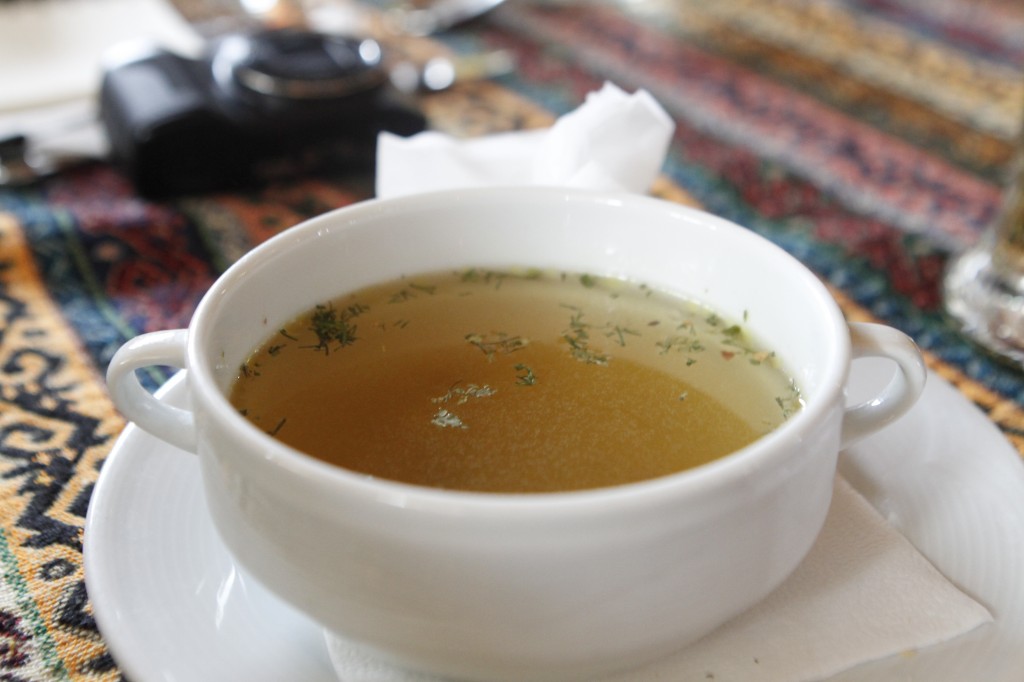
Artuur is a natural storyteller as he tells us about Karaim heritage, history and culture. He teaches us a few words in Karaim, including Tabu (hello) and Savuka (Cheers) as we toasted with our beers and Krupnik….that was before we devoured our Chenach, a stew made with chicken, potatoes, garlic, carrots, garlic and onions. And, in traditional Eastern European style, it was served with a dollip of sour cream. SKANOUSH, he says. Huh? Bon Appetit, of course.
His Story of the History:
During the 600 years that they have lived in Lithuania, this small Turkic people have preserved a strong national consciousness. A rather inward-looking community life, firm moral principles based on the teachings of the Karaim religion, and steadfast adherence to tradition have all contributed to the survival of the people, of their basic characteristics, such as language, customs, and rituals, and ultimately of their national identity. What also helped the Karaims of Lithuania survive under difficult conditions was the tolerance and respect for them expressed during all those centuries not only in the everyday contacts between people but also in the official state documents of various periods.
The still living Karaim language, which belongs to the West Kipchak subgroup of the Turkic family of languages, receives the most attention. It is being studied from several angles – as a language that has preserved rare old forms and words that have disappeared from other languages of the Turkic family and also as one that has borrowed and in its own way adapted some features of vocabulary and syntax from neighboring languages (Lithuanian, Russian, and Polish). According to our host Artuur (like Arthur he says with a smile), Latvian is the closest language in the region.
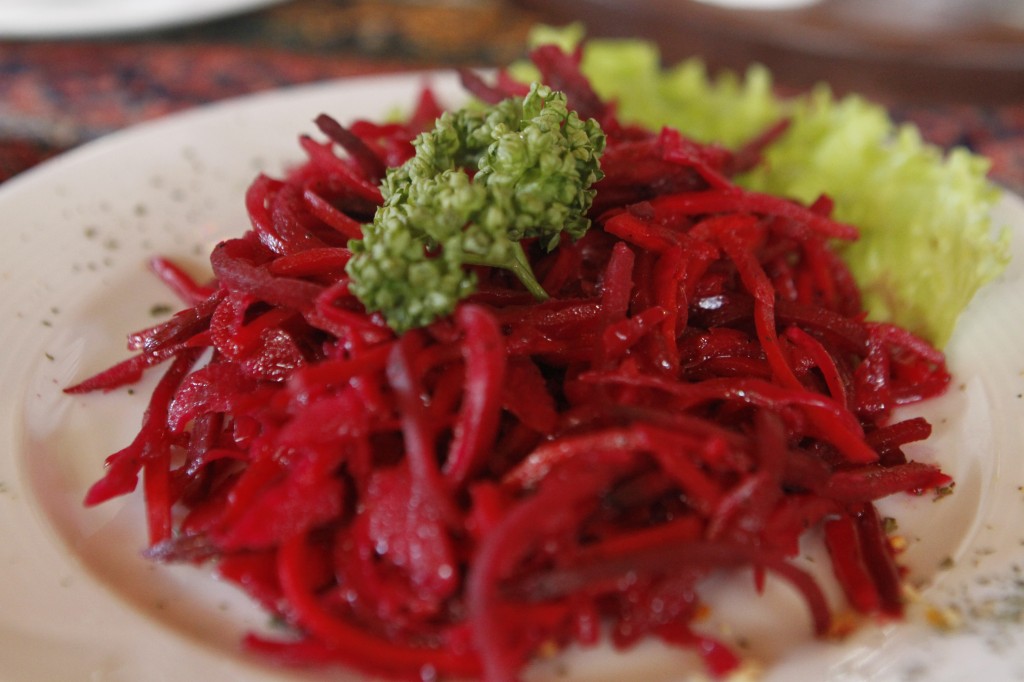
The dishes are influenced from many regions, including Turkey, Russia, Lithuania and others. We had a soup broth with a pastry, filled with your choice of chicken or beef. They also dished up a yummy beet salad (see above). The Turkish influence in their food comes from their historical connection to the Turks. From a linguistic and ethnogentic point of view, the Karaim people belonged to the oldest Turkish tribes – the Kipchaks. Their connection to Lithuania however dates back as far as 1397. Their religion is based on the Old Testament and th moral foundation of their religion is the Ten Commandments.
The story goes, says our host Artuur, is that the Great Duke of Lithuania Vytautas, brought a few hundred Karaim familes with him from Crimea in the late 1300s and they settled in the Trakai area (where this restaurant is housed), between two castles of The Great Duke, which today is simply Karaim Street.
Their cuisine, like in Turkey, includes a lot of meat and paste dishes. Most famous is the kybyn, a leavened half moon shaped paste cake stuffed with lamb or beef and baked in an oven. We tried them here, together with a soup, desserts and coffee. Their culture tends to use a lot of herbs and spices, particularly muscat nuts, cinnamon and cloves. They also served Kiubeten (pastry filled with meat) and Canach, which is a soup with a pastry across the top, served with butter.
Like most Eastern European eateries, there’s plenty of beer on tap to choose from, from dark beers and ales to lighter lagers.
Later, he brings us all a shot of Kruptic, which is an alcohol drink in a shot glass that tastes like cinnamon. The drink includes natural roots, herbs, cardimon and cinnamon. Ahhh, down it goes and with it, a whole lotta warmth!
Address:
Karaimų 29
Trakai, Lithuania
+370) 528 551 79
www. kybynlar.lt
Note: the meal was sponsored by the Lithuanian Tourism Board but all opinions expressed are my own.
Renee Blodgett is the Founder and Managing Editor of We Blog the World, a global travel, culture and lifestyle publication exploring the world through the lens of meaningful experiences, human connection and cultural depth. Having lived in 10 countries and traveled to 95, Renee has spent much of her life immersed in the people, traditions, landscapes and ideas that shape how we experience the world.
Since launching We Blog the World in 2007, she has written and produced extensive editorial coverage spanning boutique and luxury travel, culinary experiences, arts and culture, wellness, adventure, technology, spiritual traditions and transformative travel. Her work is rooted in the belief that travel is about more than where we go—it is also about what a place, culture or encounter awakens within us.
Renee brings more than three decades of experience across journalism, photography, media, brand strategy, technology, wellness and global storytelling. She has worked with companies and organizations around the world on brand positioning, communications, product launches, media strategy, speaker positioning and storytelling. Through Blue Soul Media, she works with authors, entrepreneurs, thought leaders and purpose-driven brands to clarify their message and expand their impact, which includes speaker coaching/training for high-profile stages such as TED and bringing authors’ work to market while retaining authors rights.
She is also the co-founder of Blue Soul Earth, an educational platform exploring consciousness, ancient wisdom, spirituality, healing and the intersection between science and the nature of reality. Renee is the producer and host of the award-winning Blue Soul CHATS, a conversational series bringing together leading voices in science, technology, consciousness, wellness and spirituality.
Her growing body of work also includes Blue Soul Living, which extends her interest in consciousness and well-being into the spaces we inhabit, exploring how intentional design, energy and environment can support greater harmony and connection.
Renee is the award-winning co-author of the bestselling Magdalene’s Journey and founder of the Magdalene Collection, inspired by women’s voices, stories and wisdom across cultures and generations.
A longtime photographer and storyteller, Renee has documented people, places and cultures around the world and produced photographic collections focused on destinations including the Galápagos Islands, London, South Africa, Rome and Ecuador. She also co-founded Traveling Geeks, an international initiative that brought entrepreneurs, journalists, creators and technology leaders together with their counterparts in other countries to exchange ideas and explore innovation across cultures.
Renee’s work has been recognized by Forbes, the United Nations and others for her influence in media and social storytelling. Across her work in travel, media, consciousness and culture, a common thread remains: curiosity about the world, the stories that connect us and the ways meaningful experiences can change how we see ourselves and one another.