


Many of us who grew up in the 1950s–1970s first encountered classical music and opera through cartoons rather than concert halls. Gioachino Rossini’s opera The Barber of Seville may be one of the greatest examples of that phenomenon, which I had an opportunity to see at the SF Opera recently.

As an interesting aside, The Barber of Seville is also classified as an opera buffa because it’s a comedic opera. The Italian humor and absurd twists and turns may very well be the reason it’s one of my favorite operas. That and the fact that I first heard Rossini’s music through the Bugs Bunny cartoon called Rabbit of Seville, released by Warner Brothers in 1950.
How many of you remember it? Unlike the original opera, Bugs hijacks the opera setting and turns Elmer into an unwilling customer in an absurdly hilarious barber routine. Also unlike the original, there’s no romance nor vixen female character Rosina, yet as children, we didn’t know nor did we care. Only later in life did we discover that melodies we thought only lived within the box of cartoons were actually centuries-old compositions.
I used to dance around the TV room every time we saw the Bugs Bunny rerun, with my grandfather’s hat on my head and my great grandmother’s cane in my hand. As children, we absorbed opera without realizing it and with that absorption, the music expanded our consciousness in ways we may never fully understand. Generations of children heard Rossini, Wagner, and other classical composers in our living rooms before ever stepping into an opera house.
Opera as a Pathway to Expanded Consciousness
Think about it: Opera combines music, story, language, breath, movement, symbolism, and emotion into a single experience. I suppose you could say the same thing about musicals; however, Broadway performances don’t leave me feeling the same as operas do.
With most musicals, I want to get up and dance. My smile widens. My inner joy expands. With opera, there’s much more drama and the repetition allows you to take in the meaning of the words for longer. The words are also shown on a monitor so you take them in alongside the music, leaving you with a very different experience.

Opera invites sustained focus. Psychologists sometimes describe immersive states like this as forms of deep engagement or altered perception of time. Many people notice that during a powerful performance, their internal dialogue quiets and they become more present. Spiritually, we can see this as ordinary thinking moving into a more receptive or expanded awareness, which naturally affects our relationship to (and with) consciousness itself.
Opera also works through emotional resonance. The human voice carries extraordinary amounts of information, most of which we’re not aware of in the moment, since it has become so normalized—tone, breath, tension, release, vulnerability, intention, meaning, drama, trauma. With opera, those emotional signals are amplified and prolonged.
In my own work, I’ve seen profound examples of healing using musical tones, whether that be our own voice (OM’ing or chanting during yoga or Kirtan), or through the use of chimes, gongs, and crystal or Tibetan bowls. Neuroscientific research suggests that music can activate networks involved in memory, emotion, anticipation, and bodily response. A sustained vocal line or orchestral swell can create sensations of openness, awe, sadness, release, or connection. In other words, people subjectively experience a widening of perspective or emotional capacity even if they don’t always know how to describe the feeling. Many years ago, I once saw a male friend tear up during an Italian opera when he never tears up. Ever.
When I play crystal bowls, there are some that play at a higher hertz and correlate to a particular chakra.
- Root chakra (Muladhara) – ~396 Hz
- Sacral chakra (Svadhisthana) – ~417 Hz
- Solar plexus chakra (Manipura) – ~528 Hz
- Heart chakra (Anahata) – ~639 Hz
- Throat chakra (Vishuddha) – ~741 Hz
- Third eye chakra (Ajna) – ~852 Hz
- Crown chakra (Sahasrara) – ~963 Hz

This is often linked to something called the “Solfeggio frequencies,” a modern re-framing of older concepts. That said, claims that particular frequencies can heal parts of the body are generally dismissed by science. Albeit the case, and although I don’t have scientific data to back up my personal experiences with sound, I’ve directly witnessed profound shifts. People may find certain frequencies calming and healing, so much so that tears come forward. Sound is transformative for the body, mind and soul.
Across spiritual traditions, sound has often been treated as sacred since ordered vibration affects human experience. It helps to regulate breathing, synchronize attention, deepen emotion, and create feelings of connection. Although we’re not participating (joining the on-stage singers for example) during an opera performance, a shift still takes place for the listener. You see, when an orchestra and singer align in timing and resonance, we are brought into a state that some might call transcendence, awe, or unity.
There’s also something unique about opera’s scale. Everyday emotions are often compressed or hidden; however, opera magnifies them. Love becomes devotion, longing becomes aria, conflict becomes chorus, grief becomes something sung rather than silently endured. From a symbolic perspective, opera gives voice to parts of consciousness that normally remain buried. Through the drama on stage, accompanied by music expressed in various frequencies, it allows us to not just experience what the performers are doing, but feel it fully and witness it in others.
This is the underlying brilliance of a really good opera.
Our consciousness expands when we become more attentive, emotionally open, embodied, and aware of dimensions of experience that are usually drowned out by ordinary life. We can become momentarily transformed when a scene (or a note) hits us in a particular way. Emotion surfaces and maybe even tears. Let them come. Transformation isn’t a one-time thing, but an opening through an opera can happen from the encounter between vibration, meaning, attention, and the human heart.

The Bridge Between Consciousness & Musical Experience
At its heart, opera asks a distinctly spiritual question: What happens when inner experience becomes fully visible and audible? Longing, grief, devotion, awe, jealousy, ecstasy, surrender—states that are often quiet and internal—are elevated into music and embodied on stage. Consider this: Opera becomes less of an imitation of life and more of an amplification of inner life.
In other words, it amplifies what is perceived as hidden in everyday life. What do I mean by this?
The characters are confronted by love, loss, revelation, sacrifice, fate, or transcendence. There’s always drama in an opera, even in a comedic one like The Barber of Seville. Their journey invites us to recognize aspects of ourselves in what unfolds on stage. In this way, opera becomes something akin to ritual theater—a shared space where people witness human experience expressed at its fullest scale and, through that witnessing, gain insight into their own interior world.
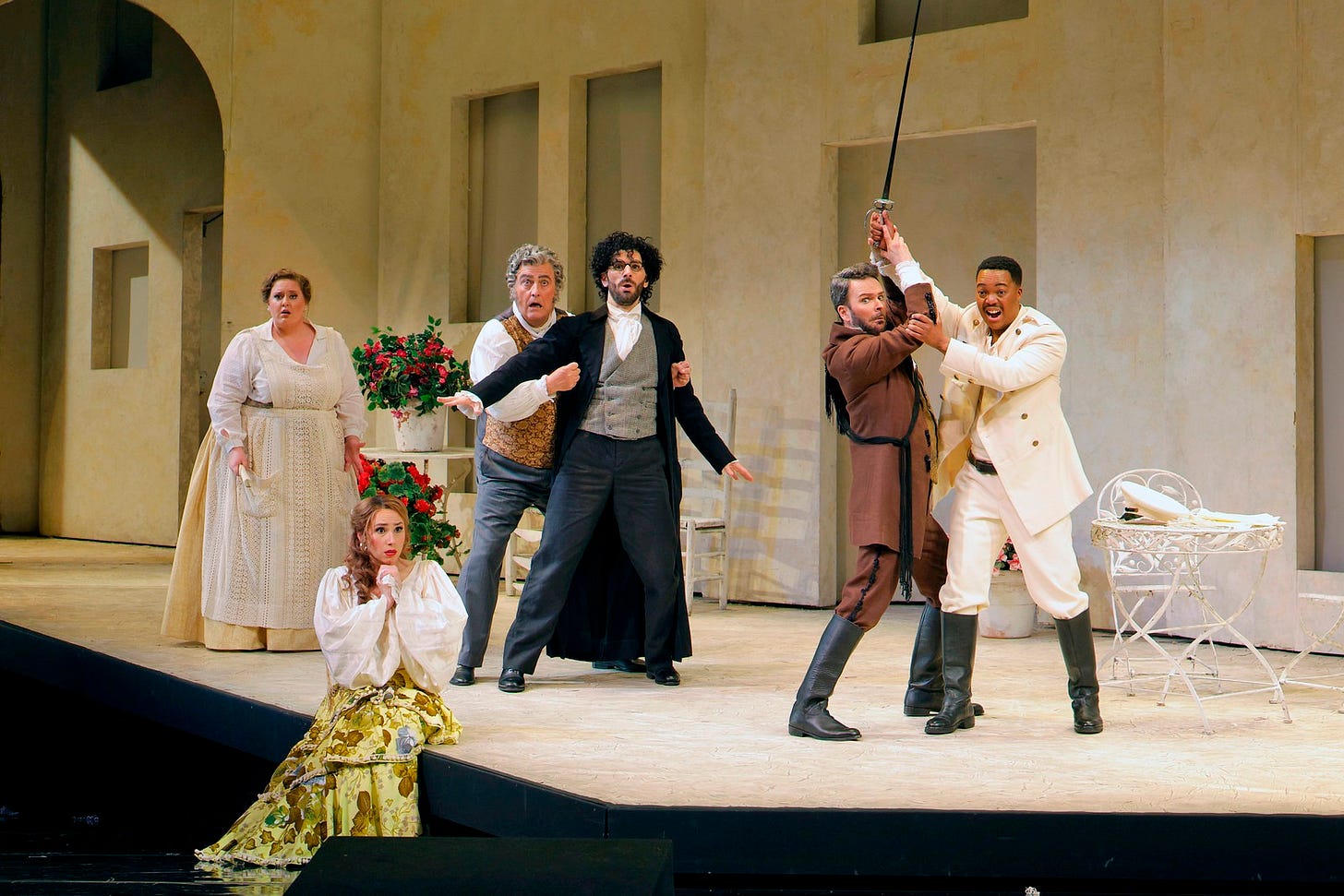
SF Opera’s The Barber of Seville. Credit: Cory Weaver/SF Opera
BTW, it should be said that in a busy life which is more true today than when most of these classic operas were written (The Barber of Seville was composed in 1816 for example), we tend to avoid doing “inner work” that helps us heal that which we have buried for years. In modern vernacular, we call it spiritual bypassing.
Obviously they didn’t have such language in the 1800’s, nor did they talk about consciousness the way we do today. I truly believe that everything has consciousness although many thinkers on the subject like to sub-categorize things rather than making such grandiose claims, i.e., Michael Pollan calls plants sentient rather than conscious, Daniel Dennett sees consciousness as something brains do, not something the universe has and Patricia Churchland views consciousness as biologically grounded in nervous systems, not spread across matter.
Regardless of where you stand on the topic, I subscribe to, among other things, the idea of Panpsychism, which suggests that everything in the universe has some form of inner experience or awareness, even if it’s extremely simple. In other words, even electrons, rocks, and trees even have a basic form of “experience” or inner aspect that we cannot directly perceive, even if it isn’t consciousness in the way humans have it.
But I digress.
I did so for a reason. Although we don’t have complete scientific evidence for consciousness yet, we can certainly give credence to our own human experiences as felt in the body . . . as embodied in everyday experience, including the effects of music.
A recurring motif can evoke memory. Harmony and dissonance can mirror inner conflict and integration if we allow it to. We must be open to having a transformative experience, whether it’s through opera, classical music or psychedelics, or it will simply build up as resistance in the body.
Opera invites us to participate in a living field of sound and emotion.
Enter The Barber of Seville
Set in the Spanish city of Seville, the story follows Count Almaviva, a young nobleman who falls in love with Rosina, a clever and spirited woman living under the watchful eye of her guardian. BTW, I had to laugh when the word vixen popped up on the supertitles above the stage to describe her. Perfect!
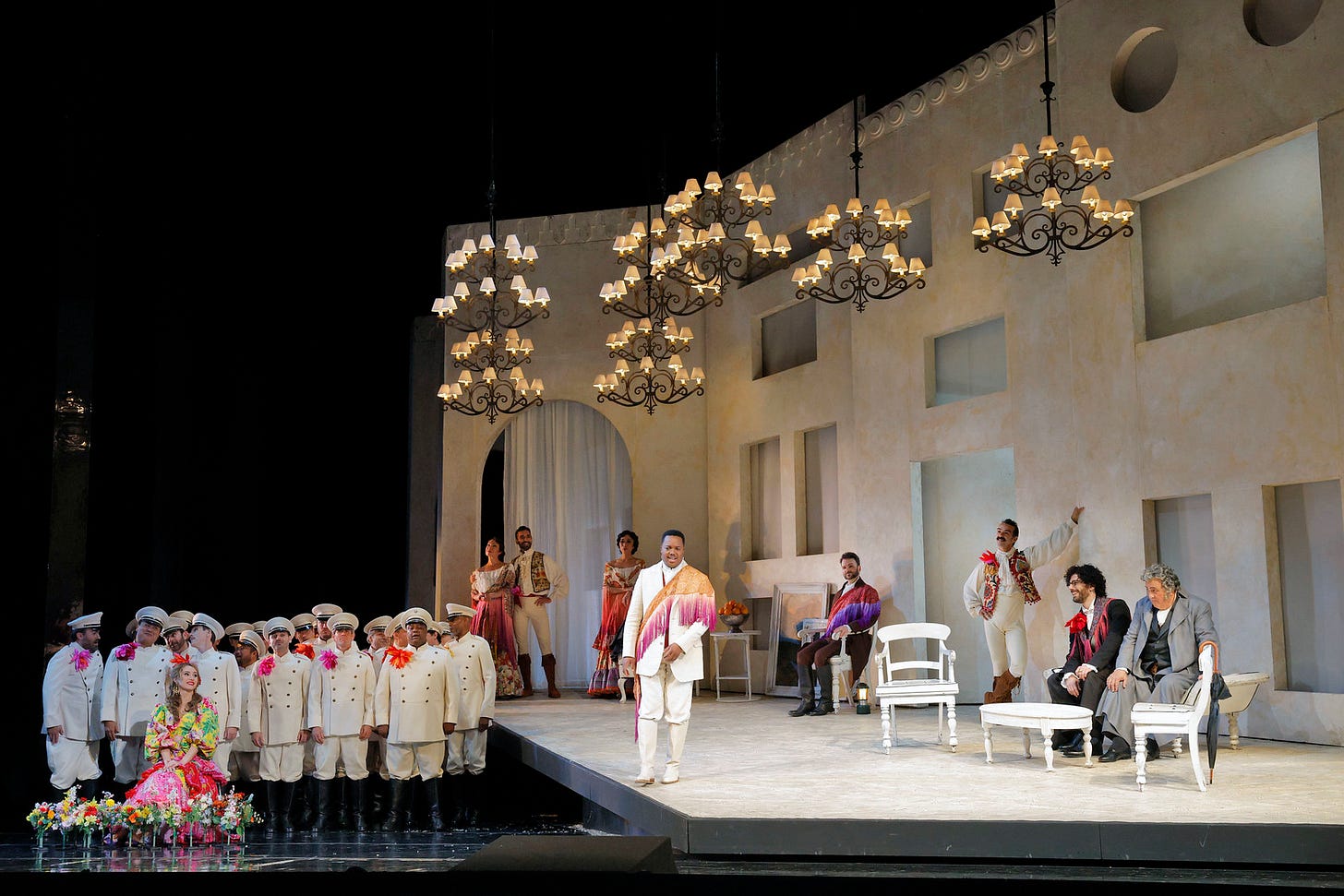
SF Opera’s The Barber of Seville / Credit: Cory Weaver/SF Opera
Determined to win her affection for who he is rather than for his status or wealth, he adopts various disguises and enlists help from an eclectic local barber whose wit and sly resourcefulness is integral to the unfolding adventure.
At the center of the opera is the barber himself. Although there are clearly differences between the scene we saw in Bugs Bunny as children, the barber is a character that oozes charisma, confidence and ingenuity, just like Bugs does in every cartoon. His humor, improvisation, and ability to outmaneuver obstacles reflect a broader theme found throughout the opera: Intelligence and creativity often triumph over control, convention, and authority.
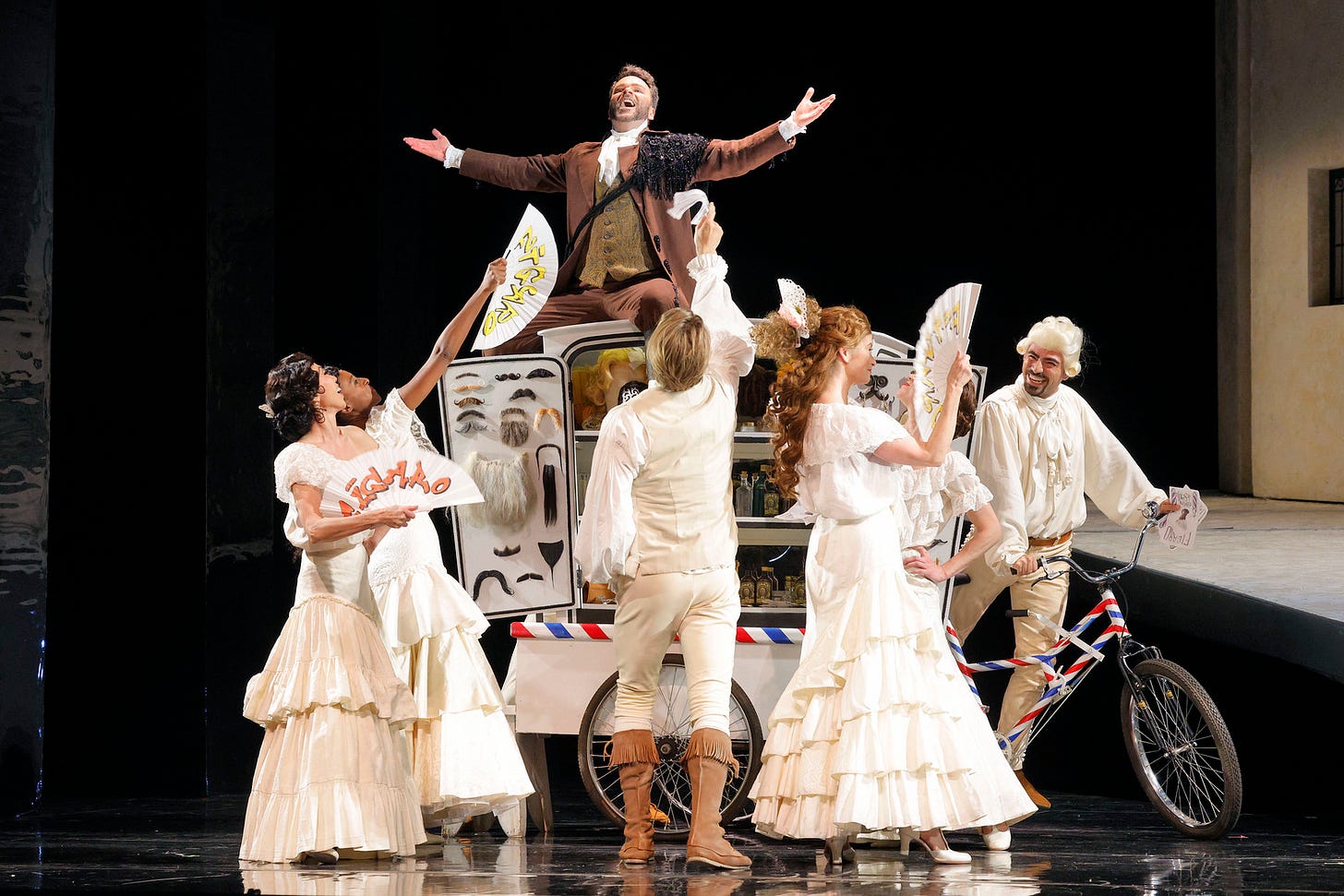
Figaro in The Barber of Seville / Credit: Cory Weaver/SF Opera
When your heart is involved in a life situation, haven’t you resorted to things outside society’s norms, rules and laws? Your heart was bigger than the fear of the consequences. Consider those who hid Jews during the Holocaust in their homes, and people who have marched for equal rights or injustice in the world.
We have seen it countless times in history. The Barber of Seville echoes the importance of our heart as a pathway to freedom. In Rosina’s case, the freedom was both external (a way to escape her fate with an abusive guardian) and internal (she chose love, even knowing that the count—in disguise—didn’t have money or resources). There are multiple lessons here.
The story unfolds through a series of misunderstandings, hidden identities, secret plans, and comic complications, emphasizing the ability for people to navigate what might be perceived as impossible circumstances in our lives. This is universal regardless of time period or where we hail from in life.
My top highlights include the sheer theatricality of the opera’s presentation, its witty comedic references and the set design, which was simple, yet elegant. In the final scene, the stage is ever so decadent with fireworks and a luxury red convertible that the Count and Rosina drive off in (obviously not part of Rossini’s 1816 opera or Beaumarchais’ original 18th-century play). This modern-staging choice may be an odd or annoying choice for opera purists; however, it added to the bizarre humor and absurdity of the opera itself, while giving it a lovely modern twist at the very end.


Like most operas, it reflects enduring human themes, exploring the very aspects of our existence that helps us expand our consciousness in daily life, such as fundamental questions around freedom, identity, social expectations, and the desire to choose one’s own path, despite the odds against you. It was also refreshing to see this vixen woman outwit her “guardian” to live a life outside what she saw as captivity, as so many women experienced during that historical time.
Characters seek connection, autonomy, and authenticity while navigating systems of control and hierarchy. These are evergreen issues, ones we deal with today as much as we did in the 1800’s. This is likely one reason why this particular opera continues to resonate across generations and cultures, long after the social customs of its original setting have changed. The opera is a wonderful example of an art that combines clever storytelling, universal themes, riveting musical composition and topics that equally open our hearts and minds, pivotal to an expanded consciousness.
Historically, The Barber of Seville was adapted from an earlier play by Pierre Beaumarchais, whose theatrical works inspired multiple operatic and literary adaptations, including the amusing Rabbit of Seville many of us cherish to this day.


Has opera changed your life? If so, in what ways? What is your memory of the Rabbit of Seville? Did it make you want to see opera in a traditional setting? If you’ve seen The Barber of Seville, what was your takeaway?

Renee Blodgett is the founder of We Blog the World. The site combines the magic of an online culture and travel magazine with a global blog network and has contributors from every continent in the world. Having lived in 10 countries and explored over 90, she is an avid traveler, and a lover, observer and participant in cultural diversity. She is also the founder of the Magdalene Collection, a jewelry line dedicated to women’s unsung voices and stories, and the award-winning author of the bestselling book Magdalene’s Journey
She is founder of Blue Soul Media and co-founder of Blue Soul Earth as well as the producer and host of the award-winning Blue Soul CHATS podcast, that bridges science, technology and spirituality. Renee also founded Magic Sauce Media, a new media services consultancy focused on viral marketing, social media, branding, events and PR. For over 20 years, she has helped companies from 12 countries get traction in the market. Known for her global and organic approach to product and corporate launches, Renee practices what she pitches and as an active user of social media, she helps clients navigate digital waters from around the world. Renee has been blogging for over 16 years and regularly writes on her personal blog Down the Avenue, Huffington Post, BlogHer, We Blog the World and other sites. She was ranked #12 Social Media Influencer by Forbes Magazine and is listed as a new media influencer and game changer on various sites and books on the new media revolution. In 2013, she was listed as the 6th most influential woman in social media by Forbes Magazine on a Top 20 List.
Her passion for art, storytelling and photography led to the launch of Magic Sauce Photography, which is a visual extension of her writing, the result of which has led to producing six photo books: Galapagos Islands, London, South Africa, Rome, Urbanization and Ecuador.
Renee is also the co-founder of Traveling Geeks, an initiative that brings entrepreneurs, thought leaders, bloggers, creators, curators and influencers to other countries to share and learn from peers, governments, corporations, and the general public in order to educate, share, evaluate, and promote innovative technologies.