


Lahore Government College, established in 1863, was followed by several other educational institutions of higher learning such as Oriental College (1865) and Forman Christian College in 1866. However, they were all affiliated with Calcutta University. Historian Latif credits the efforts of people of the province in the creation of Punjab University, which was the “result of their desire for a living and growing system of education, in the control and direction of which they may have a share and which will blend with the ancient learning of the country, and make use of its classical and vernacular languages as the media of instruction.”
 The University began its life as “the Lahore University College” and in 1869 came to be called “the Punjab University College.” The University was formally constituted on 14 October 1882, and Charles Aitchison, Lieut. Governor of the Punjab, appointed the first chancellor of the university. Contrary to the three previously established universities, which were only examining institutions, the University of the Punjab was both teaching as well as examining body right from the beginning. By 1910, 10 colleges had become affiliated to the university, many of which were located in its close vicinity. The contribution of Dr. G. W. Leitner, an enlightened Hungarian and a naturalized Britisher, was instrumental in the establishment of this University and became its first Registrar.
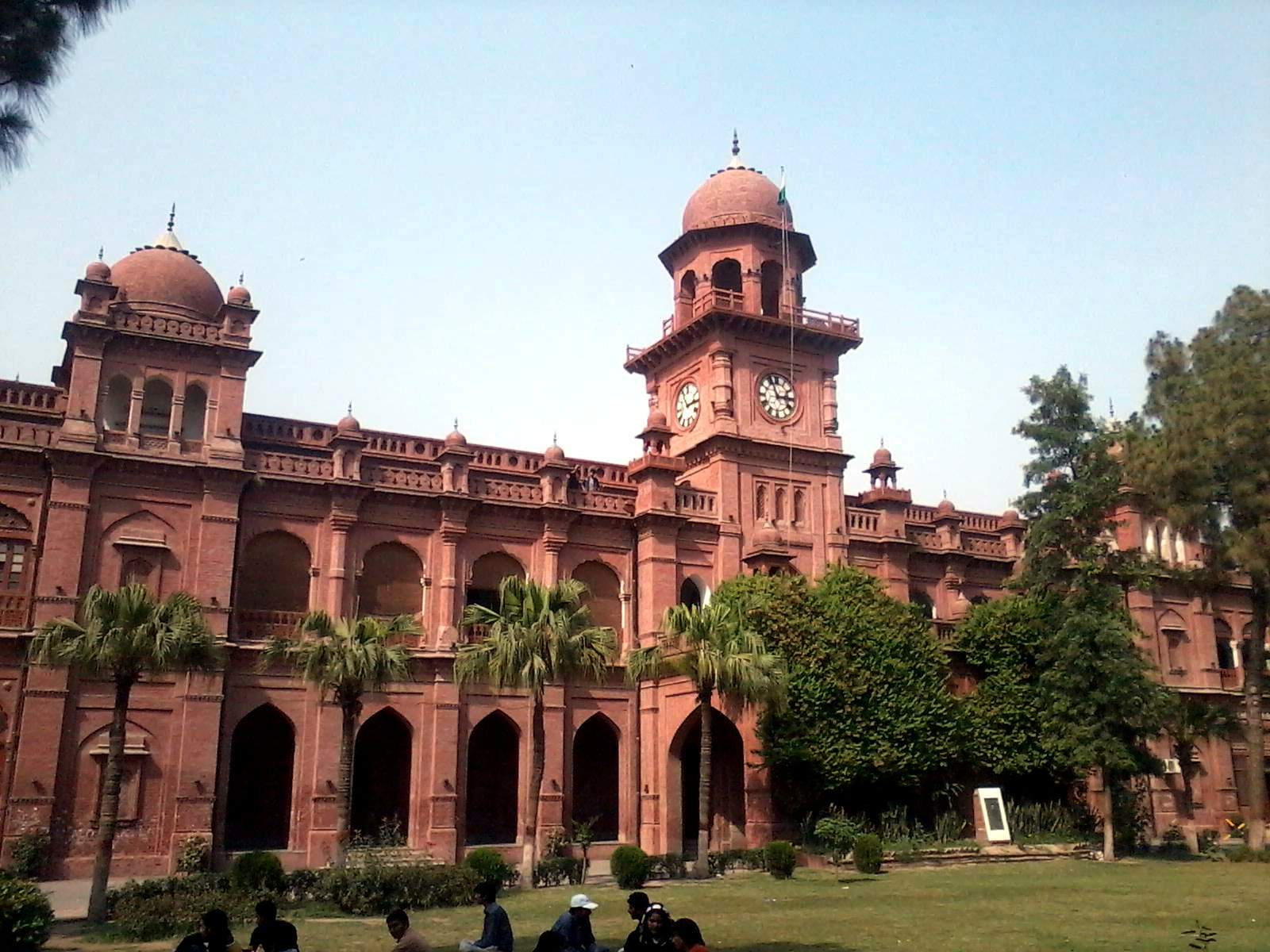
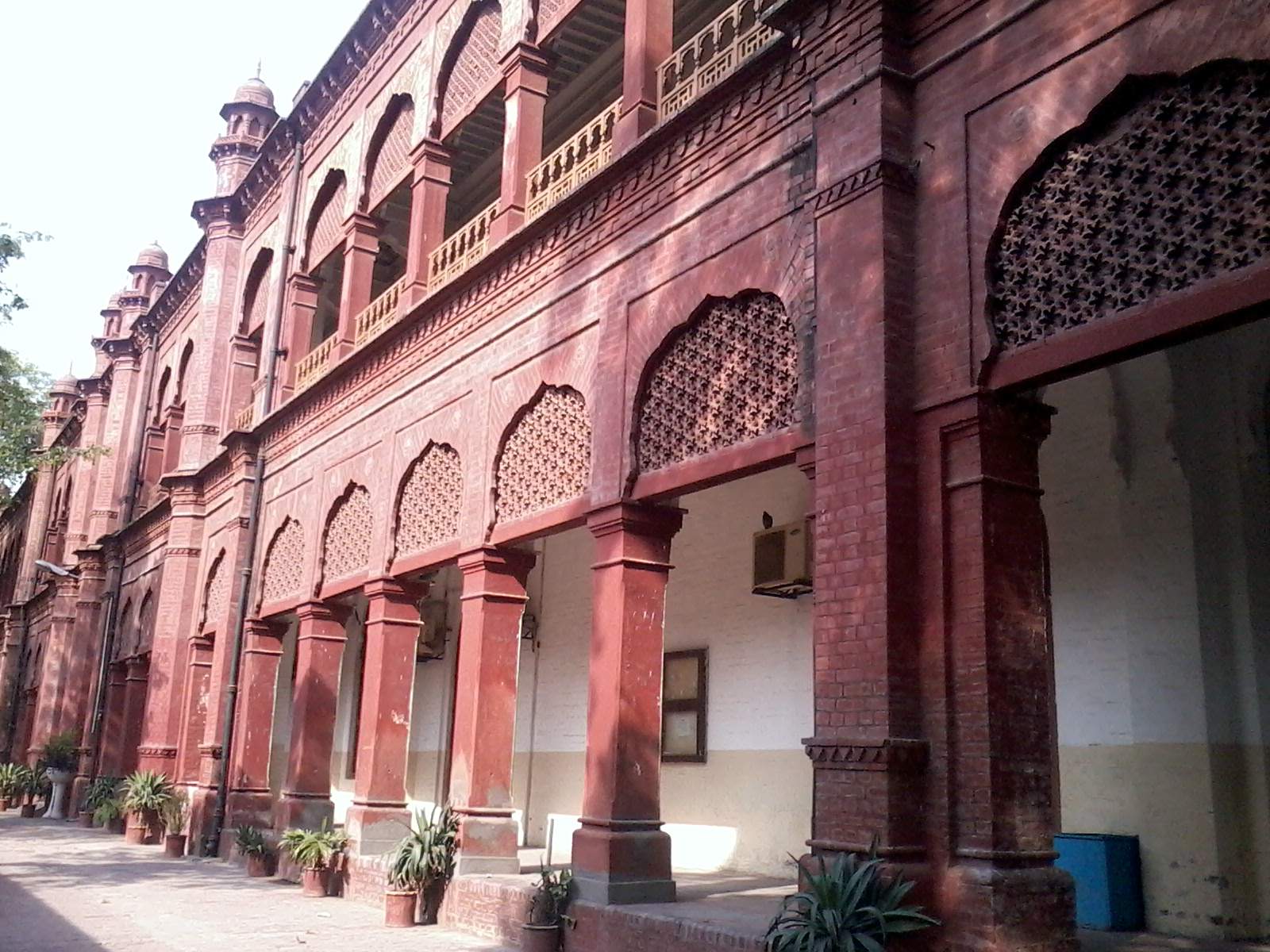
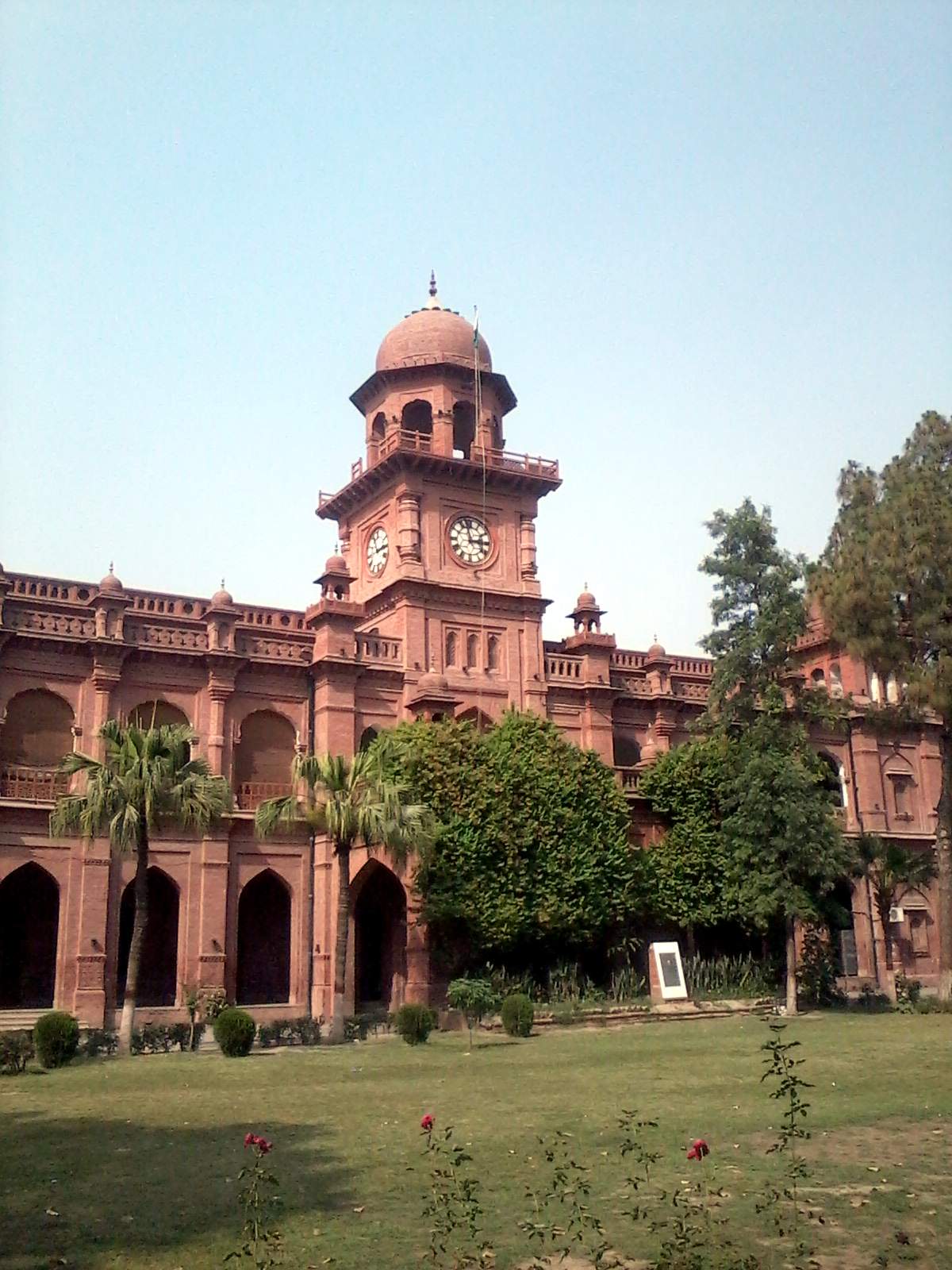 To view the Anglo-Mughal style Punjab University Hall, designed by Bhai Ram Singh, you will need to enter the gate which is directly opposite Lahore Museum. Although not as majestic as Kipling’s Anglo-Mughal museum, Punjab University Hall is nevertheless an impressive structure. Belonging to late-Anglo-Mughal style—its foundation stone was laid in 1905—the building boasts lancet arches and a profusion of cupolas in varying sizes. The two-storey building, now housing the university’s fine arts department, is designed in the manner of Raj buildings, incorporating a deep arcaded verandah front. A heavy-set clock tower, placed above the projecting porch or deorhi, dominates the centre as it rises well above the main structure and corner towers.

 Placed between the two imposing structures, but slightly set back is a small, two-storey structure built as the Punjab University Union Society, begun in 1933 to mark the jubilee celebrations of the university. The building is now known as Woolner Hall, named after a dedicated teacher of the university, who rose from the position of registrar to being its vice-chancellor. This is the same Alfred C. Woolner, whose enormous bronze statue on a granite base adorns the pavement outside the university campus.
Due to the pressure of the rising number of students and affiliated colleges, during the 1960s the university, except for a handful of departments, was shifted to a new campus, spread over 10 square miles, on a picturesque canal bank site south of the city.


Shiraz Hassan is a magazine reporter and feature writer for Sunday Magazine in Lahore, Pakistan, where he covers social issues, art and culture. At the magazine, he has published more than 400 features related to social problems, culture and ‘show biz.’ Shiraz has also worked as a news editor at the radio network “MAST FM 103” in Lahore.
He writes about culture and heritage of South Asia, particularly Pakistan. He advocates rich culture of this land and tries to explore facts. Recently he was given an award from the Federal Ministry of Population Welfare for his article on population crises. Writers Guild also awarded him a Medal of excellence for his work.