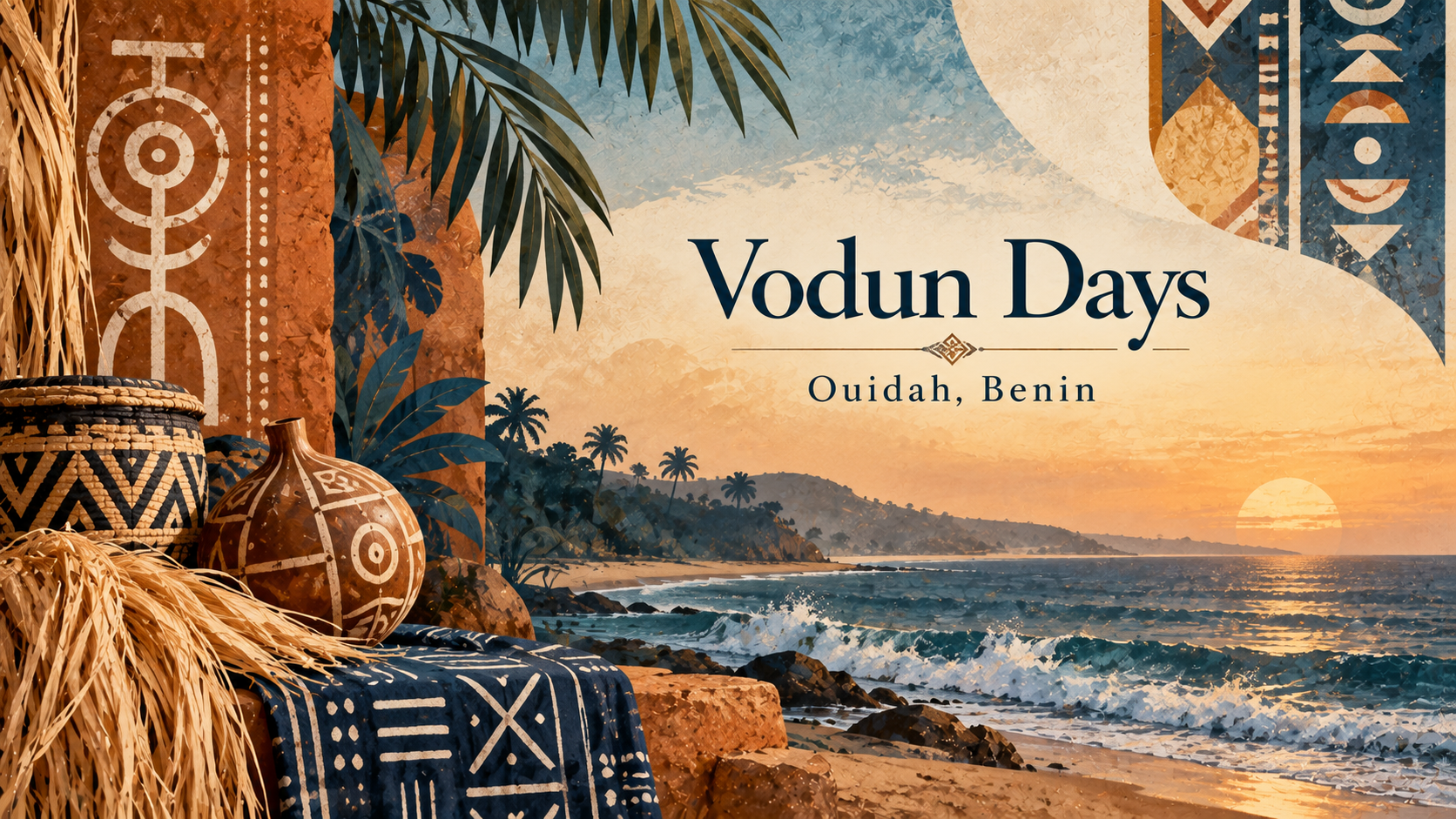
Along the Atlantic coast of West Africa, where sacred forests, ancestral shrines and centuries-old spiritual traditions remain woven into community life, an extraordinary gathering celebrates one of Africa’s most enduring religious heritages. Vodun Days, held in the historic city of Ouidah, brings together religious leaders, practitioners, artists, musicians and visitors to honor Vodun spirituality through sacred ceremonies, traditional music, dance and cultural expression.
The fourth edition takes place January 2–9, 2027, an expanded eight-day celebration confirmed by the festival’s official organizers and Benin’s government. The gathering includes religious observances, ceremonial appearances, cultural activities and concerts, creating opportunities to encounter traditions that continue to shape the spiritual identities of communities across Benin and beyond.
For travelers interested in Indigenous spirituality, ancestral wisdom, sacred relationships with nature and the African origins of religious traditions carried across the Atlantic, Vodun Days offers an unusually meaningful cultural experience. Beyond its music and public celebrations lies a complex spiritual worldview in which ancestors, divine powers, ritual obligations and community relationships remain deeply interconnected.
Understanding Vodun: A Living African Spiritual Tradition
Vodun is an established religious tradition practiced particularly in Benin and Togo, with related traditions across West Africa and the African diaspora. Its teachings and ceremonies encompass relationships with divine beings, ancestors, natural forces and spiritual powers understood through specific cultural and religious lineages.
The word Vodun is associated with spiritual or divine power within regional languages and religious traditions. Practices differ considerably among communities, and there is no single authority or uniform religious system governing all Vodun practitioners.
Religious life may involve shrines, offerings, divination, prayers, ceremonial music and responsibilities maintained by priests, priestesses and families. Knowledge is frequently transmitted through initiation, oral teaching and participation in community ceremonies.
For outsiders, Vodun has often been misunderstood through sensationalized portrayals in Western popular culture. Images of sorcery, mysterious dolls and frightening supernatural practices bear little resemblance to the complexity of the living religious traditions observed by millions of people.
A more meaningful understanding begins with recognizing Vodun as a religion in its own right, with ethical responsibilities, religious institutions, cultural knowledge and a profound connection to ancestral continuity.
Ouidah: A Spiritual Crossroads of West Africa
Ouidah occupies an extraordinary place in Benin’s cultural and religious history. Located approximately 40 kilometers west of Cotonou, the coastal city has long been associated with Vodun spiritual traditions, religious shrines and the movement of people and ideas across the Atlantic world.
Its historical significance is also inseparable from the transatlantic slave trade. During the eighteenth and nineteenth centuries, Ouidah became an important port through which enslaved Africans were forcibly transported to the Americas.
The city’s memorial landscape includes the Door of No Return, a monument commemorating the suffering and displacement associated with that history. These overlapping histories make Ouidah particularly meaningful. It is a place where spiritual traditions have been preserved within communities while their influence has also traveled, under profoundly painful historical circumstances, across oceans and generations. The official festival program brings celebrations into public squares, historic locations and coastal spaces, including areas near the Door of No Return and the Kpassè Sacred Forest.
For thoughtful travelers, exploring Ouidah means encountering both living spirituality and historical memory, while recognizing the complex relationship between African heritage and the wider diaspora.
Divine Powers, Ancestors and the Sacred Natural World
Within Vodun religious traditions, relationships between people and the spiritual world are expressed through a diverse range of divine beings and sacred powers. Some are associated with particular natural elements, such as water, thunder, earth or specific trees, while others relate to protection, social responsibilities, healing or particular community lineages.
These associations are not simply symbolic descriptions of nature. Within the religious lives of practitioners, they form part of relationships sustained through ritual, prayer, offerings and inherited obligations. Ancestors also occupy important places within many Vodun traditions. Honoring them helps maintain bonds between generations and reinforces the understanding that the living remain connected to those who came before them.
The sacred natural environment is similarly significant. Particular groves, trees, waterways and other locations may be regarded as places of spiritual presence or religious responsibility. For readers interested in sacred ecology, Vodun provides a perspective in which nature is not merely a backdrop for human life, but part of a world of relationships carrying religious and communal obligations.
Zangbeto: Guardianship, Mystery and Community Protection
Among the most distinctive traditions associated with public Vodun celebrations are the Zangbeto, often recognized through elaborate conical costumes made from layered raffia or other fibrous materials. Associated particularly with communities in southern Benin, Zangbeto traditions have longstanding connections with nighttime guardianship, community protection and social order.
Their ceremonial appearances may include movement, music and ritual expressions whose deeper religious meanings depend on the particular communities involved. For visitors, the visual character of Zangbeto ceremonies can be striking. However, the costumes are not simply artistic inventions or festival entertainment. They are connected with religious institutions and community responsibilities that deserve respectful treatment. The official Vodun Days program identifies Zangbeto appearances among its major cultural and religious activities.
Egungun and the Presence of the Ancestors
Another important tradition represented at Vodun Days is Egungun, associated particularly with Yoruba ancestral masquerade practices. Egungun performances may involve richly layered textiles, movement, music and ceremonies through which ancestral presence is honored within the community.
These traditions express the importance of relationships between living families and departed generations, although interpretations and ceremonial requirements vary considerably by community. The distinction between Egungun and other Vodun-related practices is important. Benin contains multiple religious and cultural lineages that interact historically but should not be treated as interchangeable.
During public festivities, visitors may encounter expressions from several traditions, each carrying particular meanings and responsibilities. For travelers interested in ancestor reverence, Egungun provides an opportunity to consider how cultural memory and religious belief are sustained through ceremony rather than preserved solely through written history.
Sacred Drumming, Dance and Devotional Expression
Music is central to many Vodun ceremonies. Drumming, singing, rhythmic movement and call-and-response traditions can accompany religious observances, bringing together communities through shared patterns of sound and participation. Specific rhythms may be associated with particular deities, ceremonies or lineages. Their religious significance is not always apparent to outsiders, but for practitioners they may form part of a highly structured ritual language.
Dance can similarly carry meanings connected with devotion, spirit presence, social relationships and religious obligations. During Vodun Days, traditional performances take place alongside contemporary concerts and artistic programming. This combination reflects the organizers’ intention to celebrate both religious heritage and Benin’s wider cultural creativity.
Importantly, a public concert should not automatically be interpreted as a sacred ceremony. The religious and artistic dimensions of the gathering overlap in places, but they also have distinct purposes.
The African Diaspora and the Survival of Spiritual Memory
One of the most compelling aspects of Vodun heritage is its relationship to the African diaspora. Through the forced movement of enslaved Africans, religious beliefs and practices associated with West African spiritual traditions traveled to the Caribbean, Brazil and other parts of the Americas.
Over generations, these traditions developed into religious expressions shaped by local histories, interactions with Christianity and the continuing efforts of communities to preserve inherited knowledge. Haitian Vodou, for example, has important historical relationships with West African Vodun, while also possessing its own distinct religious development and practices. Brazilian traditions such as Candomblé similarly reflect diverse African inheritances that should not be reduced to a single origin.
For people exploring their ancestral heritage, visiting Benin may offer meaningful opportunities to learn about the religious and cultural worlds from which aspects of Afro-Atlantic spirituality emerged. Ouidah’s historical setting makes these connections especially powerful, bringing together themes of cultural continuity, displacement, survival and remembrance.
Vodun Days as Cultural Renewal
The contemporary Vodun Days festival also represents an important development in Benin’s efforts to recognize and share its cultural heritage. The first edition took place in January 2024, and the event has expanded significantly since then. According to the organizers, attendance exceeded 435,000 in 2025, reflecting the growing national and international interest in the celebration.
The festival brings together traditional religious institutions, public cultural programming, artisans and tourism initiatives while presenting Vodun as an essential part of Benin’s living identity. Yet the scale of the event also creates responsibilities. Religious traditions should not be reduced to commercial spectacles, and the participation of sacred institutions requires continuing respect for the boundaries between public celebration and private ceremony.
For visitors, the most rewarding experience comes from appreciating this complexity rather than approaching the festival solely in search of unusual images or dramatic performances.
Exploring Ouidah Beyond the Festival
Ouidah offers several important cultural and historical locations worth exploring with knowledgeable local guides. The Kpassè Sacred Forest is closely associated with local religious traditions and the region’s historical identity. The Python Temple provides another introduction to religious practices maintained within the city.
The Door of No Return and sites associated with the former slave trade offer a more somber encounter with the region’s history. These places should be experienced with sensitivity, recognizing that sacred sites and memorial landscapes carry meanings extending far beyond tourism. Visitors may also explore local crafts, food traditions, music and contemporary artistic life, discovering a region whose cultural identity cannot be defined by a single festival.
Respectful Travel and Sacred Boundaries
Attending Vodun Days requires particular sensitivity because the program combines public cultural celebrations with religious observances. Not every ceremony is open to photography or unrestricted participation. Some practices may be reserved for initiates, clergy or particular communities. Travelers should follow local guidance, ask permission before photographing religious participants and avoid touching sacred objects or entering restricted shrine areas.
Engaging local guides who understand both the cultural and religious dimensions of the event can provide valuable context and help visitors avoid misunderstandings. The goal is not merely to witness something unfamiliar, but to encounter another spiritual tradition with the same seriousness and respect one would extend to any major world religion.
Planning Your Visit
The fourth edition of Vodun Days takes place January 2–9, 2027, in Ouidah, Benin. The official festival program includes ceremonies, traditional music, cultural activities and concerts, with individual schedules and access details available through the organizers.
The principal national religious holiday falls on Friday, January 8, with January 7 also designated a public holiday under Benin’s revised legislation. International travelers generally arrive through Cotonou’s airport before traveling west to Ouidah. The official festival information estimates the road journey at approximately one hour, depending on traffic.
Accommodation should be arranged early because the event attracts substantial crowds. Travelers should also confirm current visa requirements, yellow-fever vaccination requirements and other health recommendations before departure. Ultimately, Vodun Days offers a remarkable opportunity to discover the living spirituality of West Africa. Through ancestral remembrance, sacred traditions, music and cultural expression, the gathering reveals how religious heritage continues to connect communities with their history, identity and the unseen dimensions of existence.
For more information, visit: https://vodundays.bj/en/.

Renee Blodgett is the Founder and Managing Editor of We Blog the World, a global travel, culture and lifestyle publication exploring the world through the lens of meaningful experiences, human connection and cultural depth. Having lived in 10 countries and traveled to 95, Renee has spent much of her life immersed in the people, traditions, landscapes and ideas that shape how we experience the world.
Since launching We Blog the World in 2007, she has written and produced extensive editorial coverage spanning boutique and luxury travel, culinary experiences, arts and culture, wellness, adventure, technology, spiritual traditions and transformative travel. Her work is rooted in the belief that travel is about more than where we go—it is also about what a place, culture or encounter awakens within us.
Renee brings more than three decades of experience across journalism, photography, media, brand strategy, technology, wellness and global storytelling. She has worked with companies and organizations around the world on brand positioning, communications, product launches, media strategy, speaker positioning and storytelling. Through Blue Soul Media, she works with authors, entrepreneurs, thought leaders and purpose-driven brands to clarify their message and expand their impact, which includes speaker coaching/training for high-profile stages such as TED and bringing authors’ work to market while retaining authors rights.
She is also the co-founder of Blue Soul Earth, an educational platform exploring consciousness, ancient wisdom, spirituality, healing and the intersection between science and the nature of reality. Renee is the producer and host of the award-winning Blue Soul CHATS, a conversational series bringing together leading voices in science, technology, consciousness, wellness and spirituality.
Her growing body of work also includes Blue Soul Living, which extends her interest in consciousness and well-being into the spaces we inhabit, exploring how intentional design, energy and environment can support greater harmony and connection.
Renee is the award-winning co-author of the bestselling Magdalene’s Journey and founder of the Magdalene Collection, inspired by women’s voices, stories and wisdom across cultures and generations.
A longtime photographer and storyteller, Renee has documented people, places and cultures around the world and produced photographic collections focused on destinations including the Galápagos Islands, London, South Africa, Rome and Ecuador. She also co-founded Traveling Geeks, an international initiative that brought entrepreneurs, journalists, creators and technology leaders together with their counterparts in other countries to exchange ideas and explore innovation across cultures.
Renee’s work has been recognized by Forbes, the United Nations and others for her influence in media and social storytelling. Across her work in travel, media, consciousness and culture, a common thread remains: curiosity about the world, the stories that connect us and the ways meaningful experiences can change how we see ourselves and one another.