In the limestone hills north of Kuala Lumpur, where immense caverns rise above colorful temple stairways and towering cliffs, one of Hinduism’s most extraordinary expressions of devotion brings thousands of worshippers together in a spiritual journey shaped by faith, discipline, surrender and gratitude. Thaipusam, celebrated by Tamil Hindu communities around the world, is especially significant at Malaysia’s Batu Caves, where pilgrims honor Lord Murugan through offerings, prayer, fasting and acts of personal dedication.
Observed on January 22 in 2027, the festival falls during the Tamil month of Thai and is closely associated with the full moon and the star Pusam. Although its rituals can be visually dramatic, Thaipusam is far more than a colorful gathering or a demonstration of physical endurance. For devotees, it represents a deeply personal relationship with the Divine, a time for fulfilling vows, expressing gratitude and seeking spiritual renewal.
a
The celebration offers travelers a window into a living Hindu tradition in which the body, mind and spirit become part of an integrated devotional practice. The journey toward the temple, often accompanied by chanting, rhythmic drumming and collective encouragement, reflects a belief that spiritual growth can require dedication, humility and a willingness to move beyond ordinary attachments.
Lord Murugan and the Spiritual Meaning of Thaipusam
At the heart of Thaipusam is devotion to Lord Murugan, also known as Kartikeya, Skanda or Subramaniam, a major Hindu deity especially revered within Tamil traditions. Associated with wisdom, courage, spiritual victory and the overcoming of ignorance, Murugan occupies a central place in the religious and cultural life of Tamil communities across India, Sri Lanka, Malaysia, Singapore and the wider diaspora.
An important story associated with Thaipusam concerns the vel, the sacred spear given to Murugan by his mother, the goddess Parvati. Within the devotional tradition, this divine weapon symbolizes wisdom, discernment and the power to overcome forces associated with ignorance and spiritual obstruction.
The vel is therefore more than a mythological object. For many worshippers, it represents the transformative power of divine understanding, the courage to confront personal limitations and the possibility of moving toward a life guided by greater clarity and devotion. These meanings become visible during Thaipusam through offerings, vows and pilgrimage practices that connect religious narratives with contemporary spiritual experience.
The Sacred Pilgrimage to Batu Caves
Batu Caves is among Malaysia’s most recognizable Hindu pilgrimage sites. The complex is built around limestone caves and temples devoted to Lord Murugan, with a monumental statue of the deity standing near the base of its celebrated staircase.
The 272 steps ascending toward the main cave temple have become a distinctive feature of the pilgrimage. During Thaipusam, devotees climb them carrying offerings and, in some cases, elaborate ceremonial structures known as kavadis. The physical ascent can carry symbolic meaning, representing the effort, commitment and discipline involved in spiritual practice. Yet every devotee’s experience is different. Some come to fulfill vows made during periods of personal difficulty, others to express gratitude for blessings received, and still others to participate in traditions maintained within their families across generations.
The journey also expresses a remarkable sense of community. Family members, friends, religious volunteers and fellow pilgrims provide encouragement and assistance, reminding participants that devotion is often sustained through shared responsibility and collective care.
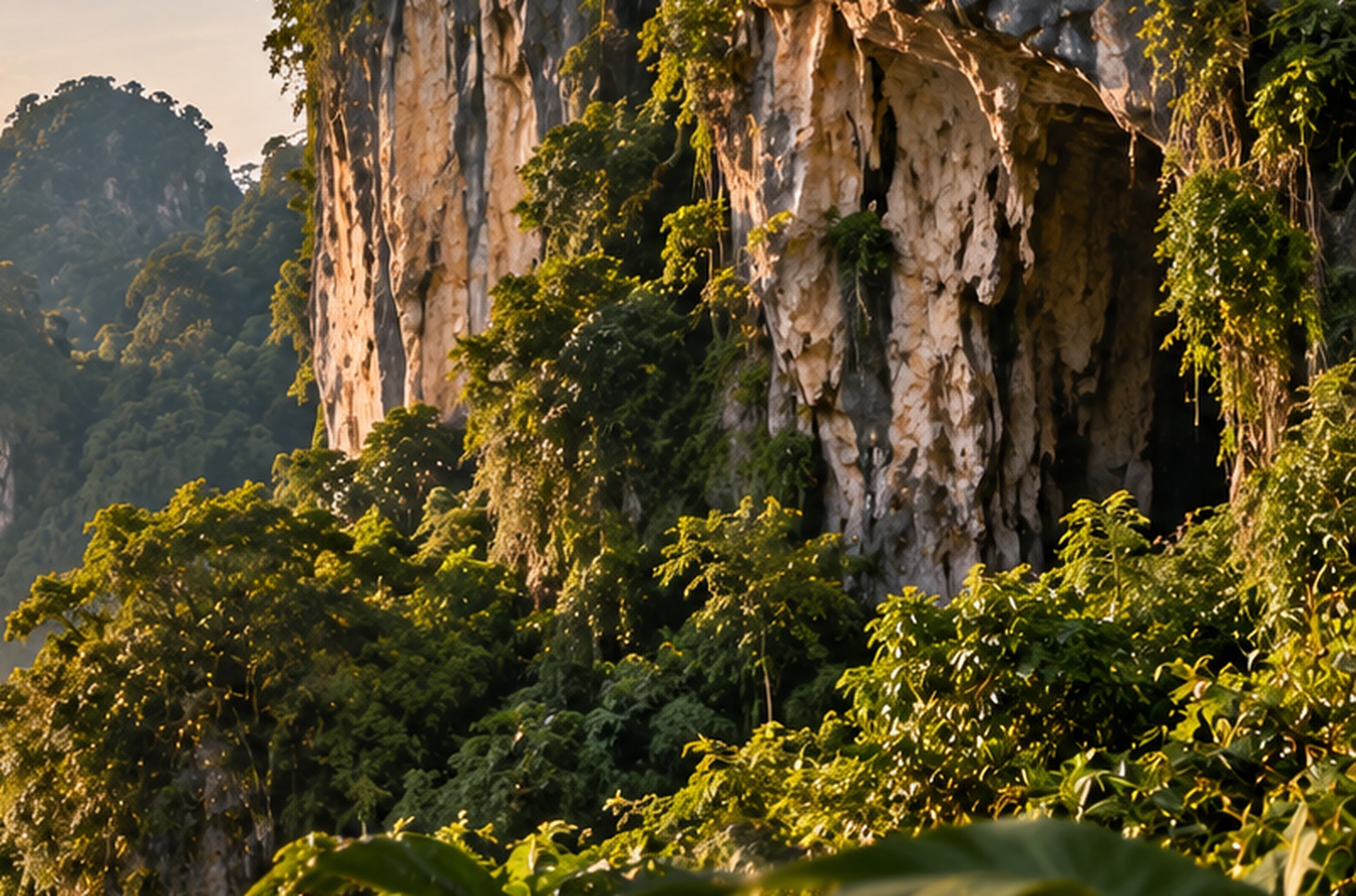
Indicative of the limestone of the area, not taken at the actual event.
Kavadi: The Burden of Devotion
One of Thaipusam’s most distinctive traditions is the carrying of the kavadi, an offering associated with vows, penance and devotion to Murugan. Kavadis vary considerably in form. Some are relatively simple wooden structures carried across the shoulders, while others are elaborate, beautifully decorated frameworks incorporating feathers, flowers, religious symbols and other ornaments. Devotees may also carry vessels of milk, known as paal kudam, to be offered at the temple.
In certain traditions, participants undergo bodily piercings as part of their vow fulfillment. These practices attract considerable outside attention, but they should not be understood simply as feats of endurance or spectacle. For those participating, they exist within a religious framework involving preparation, prayer, fasting and devotion.
Tourism Malaysia describes the period leading up to Thaipusam as one of spiritual discipline, during which some devotees observe vegetarian diets, abstinence and other prescribed practices. The length and nature of preparation may vary according to family traditions, religious guidance and individual vows.
The symbolism of carrying a burden can be especially compelling. In devotional interpretation, the weight of the kavadi may express gratitude, sacrifice, responsibility or surrender. What appears physically demanding to an observer can hold profound spiritual meaning for the person undertaking it.
The Body as an Expression of Faith
Across many spiritual traditions, disciplined physical practices have been used to cultivate attention, humility and religious dedication. Fasting, pilgrimage, prostration, sacred movement and other forms of embodied devotion reflect the understanding that spiritual life involves more than intellectual belief.
Thaipusam offers a particularly striking example of this relationship. The body becomes part of an offering through movement, endurance, ritual preparation and acts of worship.
For some devotees, the experience is accompanied by intense concentration or devotional states understood within their religious tradition. Such experiences are shaped by specific cultural and theological meanings and should not automatically be equated with modern wellness practices or generalized ideas of altered consciousness.
Instead, they invite a broader appreciation of how devotion can be expressed through disciplined action and the commitment to honor a sacred relationship.
Sacred Chanting, Music and Collective Energy
The sounds of Thaipusam contribute greatly to the atmosphere of the gathering. Chanting in praise of Murugan, religious music, percussion and the movement of pilgrims create a rhythmic environment that accompanies the journey toward the temple.
Repeated invocations such as Vel! Vel! Muruga! express devotion to the deity and the sacred spear associated with him. Within the festival’s religious setting, these chants offer encouragement, strengthen communal bonds and help maintain spiritual focus.
The collective nature of the experience can be extraordinary. Families move alongside pilgrims, volunteers distribute refreshments, and worshippers support one another through the physical demands of the celebration. For visitors, this communal dimension is one of the festival’s most meaningful qualities. Thaipusam is not merely an individual journey toward spiritual fulfillment, but also an expression of cultural belonging and mutual care.
Tamil Hindu Heritage in Malaysia
Thaipusam also provides a valuable perspective on Malaysia’s multicultural identity and the enduring religious traditions of its Tamil Hindu communities.
Many Tamil families trace their presence in Malaysia to migrations during the British colonial period, although South Indian connections with the Malay Peninsula extend much further into history. Hindu temples, festivals, languages and cultural associations have helped sustain Tamil religious identity across generations.
Batu Caves has become one of the most important centers of this heritage, drawing devotees from across Malaysia and beyond. The festival is also observed in Penang, Perak and other regions, where communities maintain their own local traditions and pilgrimage practices.
The celebration illustrates how religious identities can remain deeply connected to ancestral cultures while continuing to evolve within contemporary, multicultural societies.
A Spiritual Journey of Gratitude and Transformation
Although Thaipusam is often remembered for its visual intensity, the quieter motivations behind its rituals may be even more compelling. Gratitude, prayer, hope, repentance and personal commitment are among the experiences that bring devotees to Murugan’s temples.
The festival invites reflection on the meaning of spiritual discipline and the ways individuals seek to transform personal challenges into expressions of faith. For travelers interested in consciousness, sacred traditions and the relationship between spiritual belief and embodied practice, Thaipusam offers an opportunity to encounter perspectives that differ from familiar Western approaches to spirituality.
Its deepest significance emerges when the festival is understood on its own terms: as an expression of Hindu devotion, sustained by religious belief and the commitment of communities who continue to preserve its traditions.
Experiencing Thaipusam Respectfully
Because Thaipusam is an active religious pilgrimage, visitors should approach the celebration with sensitivity and respect.
Photography is generally possible in public areas, but permission should be requested before taking close-up photographs of individual devotees, particularly those participating in demanding rituals or moments of prayer.
Visitors should avoid obstructing pilgrims, touching sacred objects or treating religious practices as performances staged for tourists. Modest clothing, appropriate footwear and an awareness of local temple customs are especially important. The environment can also be crowded, hot and physically demanding, so visitors should be prepared for extensive walking and limited movement in heavily congested areas.
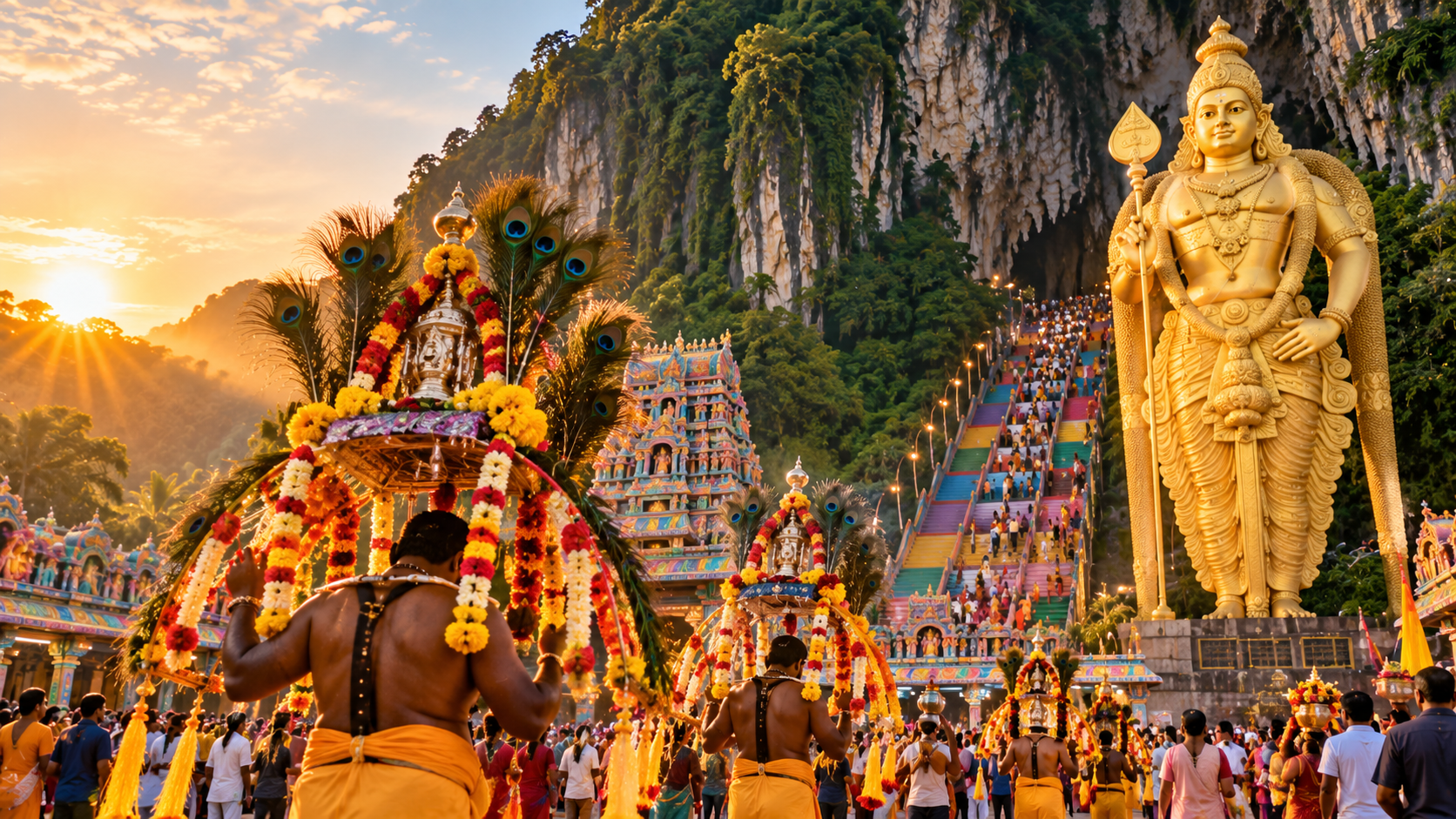
Not actually taken at the event, but symbolic as an editorial display. Not meant to represent the festival in reality.
Planning Your Visit
Thaipusam falls on Friday, January 22, 2027, with associated processions and preparations potentially taking place on surrounding days. The official religious and transport arrangements for the 2027 Batu Caves celebration should be checked closer to the event.
Batu Caves is located approximately 13 kilometers north of central Kuala Lumpur and is accessible by road and commuter rail. However, normal services and access arrangements may change significantly during the festival, making advance planning essential.
Accommodation in Kuala Lumpur offers convenient access to the wider region, although visitors should expect substantial crowds and potentially long travel times around the pilgrimage site.
Ultimately, Thaipusam is an extraordinary expression of faith in which devotion becomes visible through action. The festival reveals how religious traditions can unite body, mind and spirit while strengthening cultural memory, community relationships and the continuing relevance of ancestral teachings.
For thoughtful travelers, its greatest invitation is to look beyond the dramatic imagery and discover the devotion, gratitude and spiritual commitment that give the celebration its enduring meaning. For more information visit: https://www.tourism.gov.my/media/view/thaipusam-a-divine-hindu-celebration
Renee Blodgett is the Founder and Managing Editor of We Blog the World, a global travel, culture and lifestyle publication exploring the world through the lens of meaningful experiences, human connection and cultural depth. Having lived in 10 countries and traveled to 95, Renee has spent much of her life immersed in the people, traditions, landscapes and ideas that shape how we experience the world.
Since launching We Blog the World in 2007, she has written and produced extensive editorial coverage spanning boutique and luxury travel, culinary experiences, arts and culture, wellness, adventure, technology, spiritual traditions and transformative travel. Her work is rooted in the belief that travel is about more than where we go—it is also about what a place, culture or encounter awakens within us.
Renee brings more than three decades of experience across journalism, photography, media, brand strategy, technology, wellness and global storytelling. She has worked with companies and organizations around the world on brand positioning, communications, product launches, media strategy, speaker positioning and storytelling. Through Blue Soul Media, she works with authors, entrepreneurs, thought leaders and purpose-driven brands to clarify their message and expand their impact, which includes speaker coaching/training for high-profile stages such as TED and bringing authors’ work to market while retaining authors rights.
She is also the co-founder of Blue Soul Earth, an educational platform exploring consciousness, ancient wisdom, spirituality, healing and the intersection between science and the nature of reality. Renee is the producer and host of the award-winning Blue Soul CHATS, a conversational series bringing together leading voices in science, technology, consciousness, wellness and spirituality.
Her growing body of work also includes Blue Soul Living, which extends her interest in consciousness and well-being into the spaces we inhabit, exploring how intentional design, energy and environment can support greater harmony and connection.
Renee is the award-winning co-author of the bestselling Magdalene’s Journey and founder of the Magdalene Collection, inspired by women’s voices, stories and wisdom across cultures and generations.
A longtime photographer and storyteller, Renee has documented people, places and cultures around the world and produced photographic collections focused on destinations including the Galápagos Islands, London, South Africa, Rome and Ecuador. She also co-founded Traveling Geeks, an international initiative that brought entrepreneurs, journalists, creators and technology leaders together with their counterparts in other countries to exchange ideas and explore innovation across cultures.
Renee’s work has been recognized by Forbes, the United Nations and others for her influence in media and social storytelling. Across her work in travel, media, consciousness and culture, a common thread remains: curiosity about the world, the stories that connect us and the ways meaningful experiences can change how we see ourselves and one another.