
On an island celebrated for its vibrant ceremonies, intricate temple architecture, fragrant offerings and deeply rooted spiritual traditions, one of the most extraordinary days of the year is marked not by celebration in the conventional sense, but by silence. During Nyepi, Bali’s sacred Day of Silence, the familiar rhythms of island life give way to an extraordinary period of stillness. Roads empty, businesses close, lights are dimmed, and much of the island retreats into quiet reflection.
Observed on March 8, 2027, Nyepi marks the beginning of the Balinese Saka New Year, welcoming the year 1949 in the Saka calendar. The date has been confirmed in Indonesia’s official national holiday calendar.

For Balinese Hindus, Nyepi is a time of purification, self-restraint, contemplation and spiritual renewal. Rather than welcoming the new year through noise and outward festivities, the observance creates an opportunity to examine one’s actions, restore balance and cultivate greater awareness of the relationship between humanity, nature and the Divine.
For travelers drawn to mindfulness, consciousness and the deeper dimensions of cultural experience, Nyepi offers a remarkable perspective on the power of silence. Yet its significance extends far beyond the modern wellness world’s interest in meditation or digital detoxification. Nyepi is a sacred Hindu observance, grounded in Bali’s distinctive religious traditions and sustained through collective participation.
The Spiritual Meaning of Nyepi
The word Nyepi is associated with silence and stillness, reflecting the day’s central purpose: a deliberate withdrawal from ordinary activity to create space for religious reflection and renewal.
Within Balinese Hindu tradition, the transition into the new Saka year is an important opportunity for purification and the restoration of harmony. It invites practitioners to consider the influence of their thoughts, words and actions while strengthening their relationship with the Divine.
This approach to renewal stands in striking contrast to the outward celebrations associated with many New Year traditions around the world. Instead of emphasizing entertainment, consumption or public festivity, Nyepi encourages restraint, simplicity and introspection.
For many Balinese Hindus, these practices are connected to the larger spiritual responsibilities of living in harmony with others and the natural environment. The observance reflects a worldview in which human behavior influences not only the individual but also the wider relationships that sustain community life. Nyepi therefore invites a different understanding of celebration: one in which the absence of activity becomes an expression of sacred intention.
The Four Sacred Restraints of Catur Brata Penyepian
At the heart of Nyepi is Catur Brata Penyepian, the four principal restraints observed during the Day of Silence.
These are traditionally described as Amati Geni, refraining from fire and light; Amati Karya, abstaining from work; Amati Lelungan, avoiding travel; and Amati Lelanguan, refraining from entertainment or worldly pleasures.
Together, they create a structured period of spiritual discipline intended to quiet the senses, reduce distractions and encourage reflection. The observance is generally maintained for approximately twenty-four hours, beginning in the morning and concluding the following morning.
Indonesia Travel
The restrictions also shape the experience of the wider island. Visitors, including those who do not practice Hinduism, are expected to respect the day’s requirements by remaining within their accommodation and avoiding unnecessary noise or illumination. The streets become unusually quiet, commercial activities are suspended and ordinary tourism largely comes to a halt.
For Balinese Hindu practitioners, these conditions support religious observance. For visitors, they can also create an opportunity to appreciate the significance of collective restraint, provided the day is approached with respect for its religious foundations.
Melasti: Sacred Waters and the Journey Toward Purification
Nyepi does not begin with silence alone. In the days preceding it, Balinese Hindu communities undertake important ceremonies associated with purification and spiritual preparation. Among these is Melasti, a ritual often involving processions to beaches, lakes, rivers or other water sources regarded as spiritually significant.
During Melasti, sacred objects from temples may be carried to water for ritual purification, accompanied by prayers, offerings and religious observances. The precise practices vary between communities and religious institutions. Water holds profound symbolic significance within Balinese Hinduism, and purification rituals are understood as part of restoring spiritual balance before the transition into the new year.
The ceremonies may be visually elaborate, with participants wearing traditional clothing and carrying ceremonial objects. Yet their purpose is fundamentally religious, reflecting relationships between people, temples, sacred objects and the natural world.
For visitors, Melasti provides an opportunity to learn about the central role of water within Bali’s spiritual landscape. Photography and observation should always be guided by local expectations, particularly when ceremonies involve sacred objects or moments of prayer.
Ogoh-Ogoh: Confronting the Forces of Disorder
On the eve of Nyepi, many Balinese communities participate in Ngerupuk, observances associated with the transition from purification into the silence of the new year. One of the most recognizable elements is the procession of ogoh-ogoh, large, intricately constructed figures that often represent frightening beings or forces associated with disorder and undesirable qualities.
Created by community groups, particularly younger participants, these works can be elaborate expressions of craftsmanship and creativity. Their forms may incorporate traditional mythological imagery alongside contemporary artistic interpretations.
The processions can be accompanied by music, movement and considerable public energy, creating a striking contrast with the silence that follows. Although the figures are sometimes described simply as representations of evil spirits, their religious and cultural meanings are more complex. They can symbolize disruptive forces, moral struggles or aspects of human behavior that require recognition and transformation.
Some communities burn their ogoh-ogoh after processions, while others preserve or display them. Customs vary, and visitors should not assume that every village follows the same practices. The movement from the intensity of these observances into the stillness of Nyepi can be understood as part of a larger transition from disorder toward purification and renewed balance.
Tri Hita Karana: Harmony Between People, Nature and the Divine
One of the philosophical concepts frequently associated with Balinese Hindu life is Tri Hita Karana, which emphasizes harmonious relationships between human beings and God, among people, and with the natural environment.
This framework offers a meaningful way to understand the wider significance of Nyepi. The day’s restrictions temporarily interrupt patterns of activity that shape ordinary life. Traffic slows to a halt, many commercial activities cease and the usual sounds of tourism and commerce disappear.
While it would be simplistic to interpret Nyepi primarily as an environmental initiative, the observance provides a compelling illustration of how religious practices can influence collective relationships with the natural world. Its spiritual message is grounded in harmony, self-restraint and the responsibilities that connect individual behavior with community well-being. For travelers interested in conscious living and sustainability, these ideas can inspire reflection without diminishing the specifically Hindu meanings of the observance.
The Extraordinary Experience of an Island at Rest
For visitors accustomed to Bali’s busy streets, beach destinations, markets and cultural attractions, Nyepi can feel unlike any other travel experience. The island’s usual atmosphere changes dramatically. Outdoor excursions are suspended, roads remain quiet and even airport operations generally pause for the duration of the observance, subject to essential exceptions and official arrangements.
After dark, reduced artificial lighting can create unusually dark skies. In locations where weather and surrounding conditions permit, stars may be more visible than on an ordinary evening. Yet the most remarkable quality of Nyepi may be the shared commitment that makes the silence possible.
An entire island participates in an observance that asks individuals to place collective spiritual values above the normal demands of commerce, travel and entertainment. For visitors, the experience can prompt questions rarely considered amid the pace of modern life:
- What happens when activity is no longer the measure of a day?
- What becomes visible when habitual distractions disappear?
- And how might a period of intentional stillness influence the way we return to everyday responsibilities?
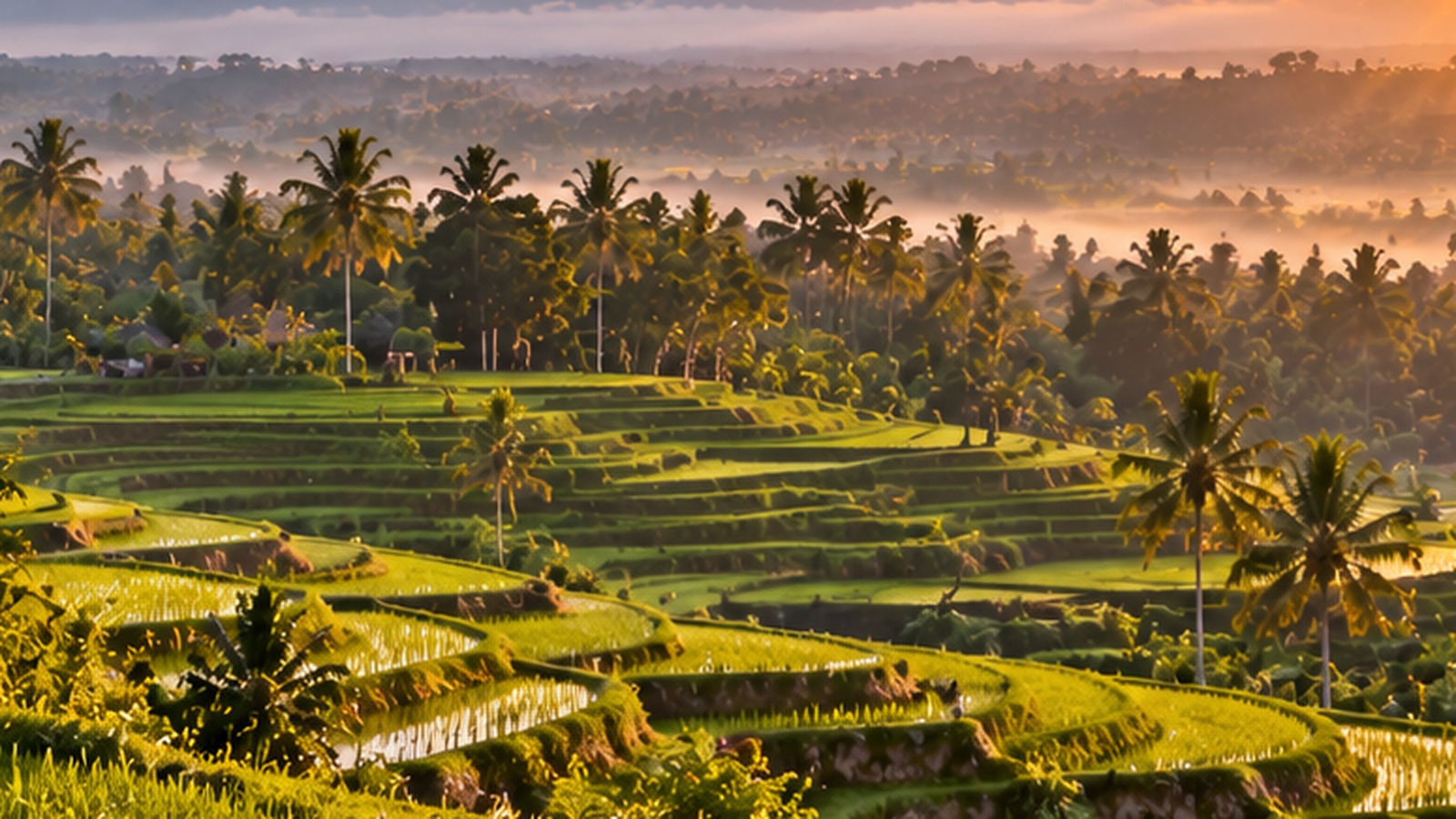
Indicative of the Balinese fields. Not meant to represent the actual site location.
Silence as a Sacred Practice
Silence appears in many religious and contemplative traditions, from Buddhist meditation and Christian monasticism to Hindu spiritual disciplines and other forms of inward reflection. Yet Nyepi possesses a distinctive character because the practice extends beyond the individual and becomes a collective observance.
The quiet is not confined to a meditation hall or retreat center. It encompasses neighborhoods, communities, public roads and much of the island’s commercial and social activity. For Balinese Hindus, the observance is embedded within religious teachings concerning purification, self-discipline and spiritual renewal.
For outsiders, it offers an opportunity to reflect on the relationship between silence and awareness, while respecting the difference between participating in a religious tradition and adopting an aspect of that tradition for personal reflection. Nyepi reminds us that stillness does not necessarily mean withdrawal from life. Within its religious context, it becomes part of preparing to reenter life with greater clarity, intention and harmony.
Ngembak Geni: Renewal and Reconnection
The day following Nyepi is known as Ngembak Geni, marking the conclusion of the period of silence and the gradual return to normal activity. For many Balinese families and communities, this is a time for visiting loved ones, renewing relationships and seeking or extending forgiveness.
Following a day devoted to restraint and inward reflection, the emphasis shifts toward reconnection and the restoration of harmony in social life. The transition offers an important perspective on the spiritual purpose of Nyepi. Silence is not an end in itself, but part of a larger process of renewal that includes one’s responsibilities to family, community and the world. In this sense, the observance moves from purification to contemplation and finally toward the renewal of relationships.
Experiencing Nyepi Respectfully
Visitors planning to be in Bali during Nyepi should understand that the observance affects nearly every aspect of daily life. Tourists are generally required to remain within their hotel, villa or other accommodation throughout the Day of Silence. Beaches, attractions, shops and restaurants outside accommodations are closed, and movement on public roads is restricted.
Hotels may provide essential services, but lighting, entertainment and outdoor activities are typically limited. Internet and communication arrangements can vary, and travelers should consult their accommodation provider for the most accurate guidance. The local traditional security officers known as pecalang help maintain observance of the restrictions, although emergency medical and other essential services remain available.
Visitors should not attempt to leave their accommodation for sightseeing or treat the unusual silence as an opportunity to photograph empty streets. The most respectful approach is to prepare in advance and allow the day to unfold according to its intended purpose.
Planning Your Visit
Nyepi falls on Monday, March 8, 2027, with the principal Day of Silence observances expected to continue into the following morning. Related ceremonies, including Melasti and Ngerupuk, take place beforehand, with exact schedules varying by village and temple.
The date is officially listed as Indonesia’s national holiday for the Saka New Year 1949.
Travelers should avoid scheduling flights, transfers or other transportation on Nyepi itself, as normal airport and road operations are significantly restricted. Exact 2027 airport closures and service exceptions should be confirmed with airlines and local authorities.
Those interested in observing ceremonies in the days leading up to Nyepi may find meaningful cultural experiences across Bali, although local religious practices and access arrangements differ considerably between communities. Ultimately, Nyepi represents one of the most extraordinary expressions of collective spiritual discipline anywhere in the world. Through silence, purification and reflection, Balinese Hindu communities reaffirm relationships with the Divine, with one another and with the natural environment.
In a world continually shaped by movement, noise and distraction, Bali’s Day of Silence offers a remarkable reminder that renewal can begin not through doing more, but through the intentional choice to become still.
For more information, visit: https://www.indonesia.travel/id/id/travel-ideas/culture/how-to-spend-the-day-in-bali-during-nyepi-or-day-of-silence

Renee Blodgett is the Founder and Managing Editor of We Blog the World, a global travel, culture and lifestyle publication exploring the world through the lens of meaningful experiences, human connection and cultural depth. Having lived in 10 countries and traveled to 95, Renee has spent much of her life immersed in the people, traditions, landscapes and ideas that shape how we experience the world.
Since launching We Blog the World in 2007, she has written and produced extensive editorial coverage spanning boutique and luxury travel, culinary experiences, arts and culture, wellness, adventure, technology, spiritual traditions and transformative travel. Her work is rooted in the belief that travel is about more than where we go—it is also about what a place, culture or encounter awakens within us.
Renee brings more than three decades of experience across journalism, photography, media, brand strategy, technology, wellness and global storytelling. She has worked with companies and organizations around the world on brand positioning, communications, product launches, media strategy, speaker positioning and storytelling. Through Blue Soul Media, she works with authors, entrepreneurs, thought leaders and purpose-driven brands to clarify their message and expand their impact, which includes speaker coaching/training for high-profile stages such as TED and bringing authors’ work to market while retaining authors rights.
She is also the co-founder of Blue Soul Earth, an educational platform exploring consciousness, ancient wisdom, spirituality, healing and the intersection between science and the nature of reality. Renee is the producer and host of the award-winning Blue Soul CHATS, a conversational series bringing together leading voices in science, technology, consciousness, wellness and spirituality.
Her growing body of work also includes Blue Soul Living, which extends her interest in consciousness and well-being into the spaces we inhabit, exploring how intentional design, energy and environment can support greater harmony and connection.
Renee is the award-winning co-author of the bestselling Magdalene’s Journey and founder of the Magdalene Collection, inspired by women’s voices, stories and wisdom across cultures and generations.
A longtime photographer and storyteller, Renee has documented people, places and cultures around the world and produced photographic collections focused on destinations including the Galápagos Islands, London, South Africa, Rome and Ecuador. She also co-founded Traveling Geeks, an international initiative that brought entrepreneurs, journalists, creators and technology leaders together with their counterparts in other countries to exchange ideas and explore innovation across cultures.
Renee’s work has been recognized by Forbes, the United Nations and others for her influence in media and social storytelling. Across her work in travel, media, consciousness and culture, a common thread remains: curiosity about the world, the stories that connect us and the ways meaningful experiences can change how we see ourselves and one another.